

By Mary Beth Roach
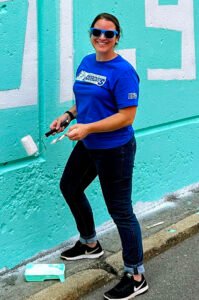
“I think it’s so cool to be a part of each one of my student’s stories. They want to be here. They want to better themselves. They want a better outlook in the next five to 10 years.”
This, according to Erica Hall, is how she views her students and her role as the director of the occupational therapy assistant program at Bryant & Stratton. And she is part of their story even before they walk through the door of the school on James Street in Syracuse until they graduate.
Hall came to Bryant & Stratton about 10 years ago, bringing both a strong educational background and clinical experience. She earned her master’s degree in occupational therapy from Russell Sage Graduate School in 2010, worked for Upstate University Hospital on the rehabilitation unit as an occupational therapist for five years; and earned her doctorate in July of 2025.
While at Upstate, she was often working weekends and holidays; her husband, as a physical therapist, would sometimes work Saturdays and nights; and the couple had an infant son. So, when she heard about the faculty position at Bryant & Stratton, she applied and was hired.
“I was always in that teacher mindset,” she added.
As a child, she enjoyed playing school.
“I was the kid who went to school all day, then came home and played school,” she joked. Her little sister and her dolls were her students, she said.
She started at Bryant & Stratton teaching five to six classes each semester and over the past decade, she has worked her way up to position as program director.
She still teaches, but among her responsibilities as program director she is also involved in developing curriculum, enrollment, community awareness and forming partnerships with some area nursing homes and dayhab programs that serve those with development disabilities, thereby providing students with hands-on experience. As students prepare to graduate, Hall makes sure that staff help students prepare resumes and cover letters, do mock interviews and phone calls and keep their eyes open for job listings.
During Hall’s tenure that program has adapted to meet the needs of the student population — a majority of the liberal arts courses are online, as well as two OTA classes.
“The evolution is based on the bandwidth we have to expand to support our students beyond the classroom as many non-traditional students have families and work,” she explained.
A critical component of her job is overseeing the requirements needed to maintain the program’s accreditation by the Accreditation Council for Occupational Therapy Education (ACOTE), the nationally-recognized accrediting body responsible for evaluating and accrediting occupational therapy and occupational therapy assistant educational programs. The accreditation assures that programs maintain quality, meet federal requirements and is required for graduates to sit for licensure exams. Bryant & Stratton recently celebrated 10 years of ACOTE accreditation.
She is also involved in developing articulation agreements that would enable graduates of her OTA program to pursue a higher degree and have applicable credits they earned from Bryant & Stratton transfer. She has put together one with Utica University and is working on a similar agreement with Bay Path University in Massachusetts.
But there are challenges, too, especially with the ever-changing, post-COVID healthcare field.
She noted that nationwide, enrollment in occupational therapy and OTA programs has seen a significant decrease. The Occupational Therapy Centralized Application Services has reported a drop of nearly 50% in applications to OT programs from 2016 to 2024. Those wishing for jobs in the healthcare industry will often gravitate to those with higher salary levels. Other factors for the decline include the fear of higher education costs and student loan debt.
Another challenge Hall sees is the common misconception that Bryant & Stratton is only a business school and while that was the focus in the early days of the institution, it now offers programs across a spectrum of fields.
Despite the challenges, there are achievements and about a week after our conversation with Hall, she was to see one of her greatest accomplishments — another class of students walk across the stage and graduate.
Read about more Women in Education:
• Rhonda Zajac: Women’s Role in Education Shifts to Leading
• Agatha Awuah: Educator is considered the architect behind OCC’s culture of evidence-based decision-making
• Sarah Gaffney: A product of the SUNY system, she has overseen a steady growth in enrollment at OCC
• Jennifer King-Reese: Educator is proud of fostering greater communication among the district’s schools and employees
• Linda LeMura: She became a trailblazer in 2014 as the first lay female president of a Jesuit college in the U.S.
• Jennifer Nichols: From student to dean, administrator is settling into new position
• Kirsten Nielsen: As the founder of the physical therapist assistant program, she now serves as both its director and an instructor
• Amanda Petrie: P-TECH principal is following in her grandmother’s footsteps
• Lindi Quackenbush: Her father once observed she had more degrees than a thermometer
• Jennifer L. Ross: Interim dean was once told that she couldn’t do advanced math because she was a girl
• Donna Runner: Her mother’s commitment to education spurred superintendent’s success
• Naomi Ryfun: A love of teaching: A journey from biochemistry to education

