

By Mary Beth Roach
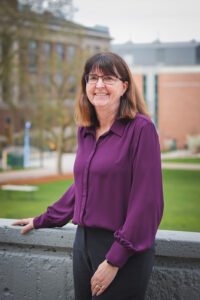
Teaching runs in Lindi Quackenbush’s family. Both her parents were elementary school teachers in her native Australia and encouraged her education.
A professor in the environmental resources engineering department, she has taught as SUNY College of Environmental Science & Forestry for 25 years, served as chair of that department from 2018 to 2024, and is now both provost and vice president of research.
She has also been a mentor for students, which she believes gives her an added perspective.
“I feel like it’s helping me have a connection to the academic programs. I understand the challenges that the students are facing.”
Having earned two bachelor’s degrees, a master’s and a doctorate, Quackenbush joked that her father has told her she’s got more degrees than a thermometer.
She was an undergraduate at the University of Melbourne, did a year at University of Maine at Orono as an exchange student; and then worked in Boston for a summer, where she met her future husband, who was from the Central New York area. She returned to Melbourne to graduate and then returned to the U.S. to continue her studies at ESF. As a grad student, she was a teaching assistant and said she loved being in the classroom. She would eventually move into a faculty position.
Now, she is ultimately responsible for making sure ESF students receive their degrees.
In assuming the leadership of the research program, which tallies about $20 million in expenditures annually, she is responsible for leading, promoting and driving research initiatives and answers directly to President Joanne “Joanie” Mahoney. As provost, the chairs of the college’s seven departments, along with the directors of the division of environmental science, math and writing programs all report to her. And, according to the ESF website, she is responsible, for “fresh ideas and perspectives to improve programs, enhancing the college’s academic reputation and strengthening contributions to global environmental and sustainable resource design, management, research and stewardship.”
She believes that having come up through the ranks at the college has given her a unique perspective and helps her to be able to engage other college stakeholders, whether through formal governance processes and meetings or simple conversations.
“That matters enormously to me,” she said.
Moving forward, she has a number of goals that encompass student and faculty satisfaction, programming, and greater community awareness.
She reiterated a phrase someone once told her — “unless you have goals, you don’t know when you get there.”
“I think that’s really important. We have to understand where we are, so that we know where we want to get to,” she said.
She would like to explore the possibility of creating greater flexibility in programming, pointing out that students are coming from different backgrounds, some of them who already have jobs but are perhaps rethinking their career paths and are considering higher education.
“We’re certainly a very hands-on campus, and I don’t want to change that, but I do want to provide greater flexibility” that would could make classes more manageable for a nontraditional student to work into their life schedule, she explained.
She is also cognizant of the need to continue to attract and retain students, faculty and staff. Toward that end, she wants to make sure that they are recognized for their part in the college’s success. Underscoring that success, the 2024-25 ESF annual report said that 97% of the Class of 2024 are employed or attending graduate school; 90% are working in a job related to their degree and 94% found a position within six months.
Quackenbush would like to see more partnerships with community organizations that would be mutually beneficial. The students receive hands-on learning experiences and the community becomes more aware of what the college does. It also exposes these organizations to a student who may want to eventually come work for them.
And she wants to find more opportunities to, as she said, “tell our story, why our campus matters.”
Read about more Women in Education:
• Rhonda Zajac: Women’s Role in Education Shifts to Leading
• Agatha Awuah: Educator is considered the architect behind OCC’s culture of evidence-based decision-making
• Sarah Gaffney: A product of the SUNY system, she has overseen a steady growth in enrollment at OCC
• Erica Hall: Program director is involved in developing curriculum, enrollment, community awareness and forming partnerships
• Jennifer King-Reese: Educator is proud of fostering greater communication among the district’s schools and employees
• Linda LeMura: She became a trailblazer in 2014 as the first lay female president of a Jesuit college in the U.S.
• Jennifer Nichols: From student to dean, administrator is settling into new position
• Kirsten Nielsen: As the founder of the physical therapist assistant program, she now serves as both its director and an instructor
• Amanda Petrie: P-TECH principal is following in her grandmother’s footsteps
• Jennifer L. Ross: Interim dean was once told that she couldn’t do advanced math because she was a girl
• Donna Runner: Her mother’s commitment to education spurred superintendent’s success
• Naomi Ryfun: A love of teaching: A journey from biochemistry to education

