More demand for medical schools in in all medical schools in Upstate New York
By Aaron Gifford
U.S. medical schools are enjoying record numbers of applications and enrollments and institutions in Buffalo, Rochester, Syracuse and Albany are certainly no exception.
Central New York’s own SUNY Upstate Medical University reported a 3.5% increase in the past decade, from 1,400 students in 2015 to 1,528 last year. That total accounts for 35 programs across four colleges. At the college of medicine, which develops future physicians, enrollment increased from 628 to 700, or 11%, during that time, said Robert Ruiz, interim vice president for educational services and dean of student affairs.
In addition, he said, the number of student applications in the college of medicine (MD programs) increased from 4,371 to 6,400 so far for first-year students in 2026-27.
“There’s clearly a demand,” he said. “People understand that Upstate is an attractive option for them. We want to recruit them, keep them and train them.”
All told, 90% of the students in each of the 35 programs are from New York state, and Upstate Medical is particularly proud of the strong contingency from Central New York counties, Ruiz said.
“It’s a school for New Yorkers, by New Yorkers, to take care of New Yorkers,” he said. “We take the name of our university seriously.”
Ruiz said Upstate Medical’s rural medical program, which trains doctors to address the needs of remote, sparsely populated and often low-income communities, has been going strong now for two decades. It was recently expanded to include a scholarship partnership with the Hudson Headwaters Health Network in Saratoga. It covers the costs of medical school for graduates who practice in one of the North Country’s eight counties for four years.
Upstate Medical also launched a three-year program for 10 specialties within the primary care sector. Its first cohort will graduate in May. This is a very popular and more affordable option for students who already know their desired specialty before they are admitted to the university, Ruiz said.
The University at Buffalo’s Jacobs School of Medicine and Biomedical Sciences currently has 700 students enrolled in the four-year medical degree program. It received 6,264 applications in 2025, an increase of 7.5% over the previous year.
UB’s medical school is one of the oldest in the nation, dating back to 1846 , and is among only 33 centers in the nation to hold distinction for both primary care and research. For the Class of 2029, with 187 students, 92% are from New York state, with 40% specifically from the Western New York region. A quarter of the first-year students completed an undergraduate degree at UB, according to its website.
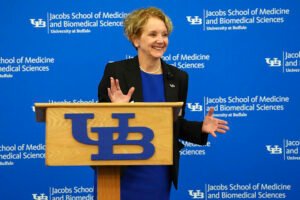
Allison Brashear, dean of the Jacobs School and UB’s vice president for health sciences, said the program is also one of only six in the country that has undergraduate components. The number of students enrolled in four-year programs in the biomedical science school reached a record 1,310 this year, while graduate and PhD. program enrollment in that school increased by 60% in the past five years.
“There’s strong interest in biology,” she said, adding that there are plenty of good-paying medical-related jobs in the region for all graduates. “Many of the students go right to work in the industry, many get a Ph.D., or go to medical or dental school.”
A master’s degree program in genetic counseling will begin in the fall of 2026.
UB is also planning a three-year program, the Buffalo Primary Care Initiative, to train and place new internists, pediatricians and family doctors within three years, rather than four. Scholarships are provided to new doctors who agree to practice in Buffalo’s low-income eastside and westside neighborhoods for five years. When that program is in place, the medical school will be allowed to increase first-year enrollment to 196 students, Brashear said.
UB’s medical school moved from the original campus on the city’s north side to a downtown facility in 2018. Its 630 faculty members work at several medical centers across the region, including the Golisano Children’s Hospital of Buffalo, the Veterans Administration Hospital and Kaleida Health.
“We very much value these partnerships,” Brashear said.
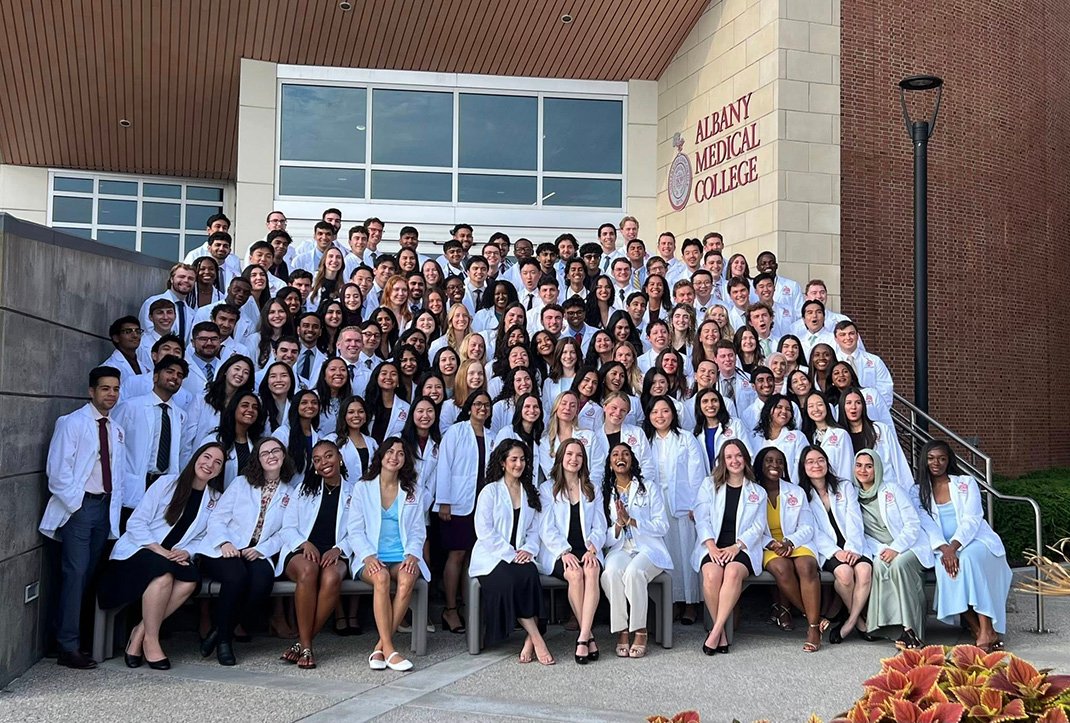
Albany Medical College, one of the nation’s oldest and smallest private institutions for training future physicians, has maintained a first-year class size of 145 students. More than 14,000 candidates applied for admission last year, said Sue Ford, Rajchel, the school’s communications director.
“We take pride in offering an intimate, collegial environment that fosters humane values and genuine learning,” she said.
The Class of 2029 is represented by 19 nations and 27 states, and 22 of the 47 from New York hail from the Capital Region, according to Albany Medical College’s website. Additionally, 41 of the new students previously completed joint degree programs at local institutions, including Siena College, Union College and Rensselaer Polytechnic Institute. Most of them have undergraduate degrees in biological sciences and 27 also earned master’s degrees.
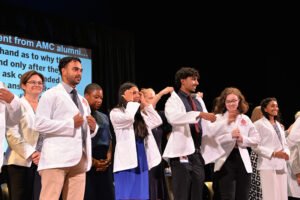
“The white coat is a powerful reminder of our commitment to deliver care with integrity, empathy and humanism,” said Alan Boulos, dean of Albany Medical College. “We are proud to support our new students in their medical journeys and look forward to growing with them as we guide them to becoming compassionate, skilled physicians.”
This year University of Rochester once again filled all available slots in its medical and dentistry programs for the undergraduate, graduate and post-graduate levels, said Barbara Ficarra, speaking for University of Rochester Medical Center. The post-doctoral program this year has 943 research trainees and saw applications increase by 34% since 2024. The nursing program has also enjoyed growth, serving more than 800 students this year and employing 180 faculty members.
U of R’s Eastman Institute for Oral Health has particularly a strong surge of interest, with dentists from 39 different countries completing training there. That program includes instruction on digital dentistry, telemedicine and the use of artificial intelligence to advance research and patient care.
Strong interest in medicine
Medical school enrollment increases are highly regulated based on industry standards and state and federal funding agencies; a significant boost in the number of students is not necessarily an indication of quality. Regardless, most medical schools are reporting an increase in applications as the United States remains in dire need of more physicians.
Still, in the months ahead, medical schools are bracing themselves for challenges like federal funding cuts for research and new federal student loan regulations that could affect future application pools.
“This is a new environ ment,” Ruiz said. “But we’re committed to going forward, not backward.”
Nationally, U.S. medical schools reported 54,699 student applications last year, a 5.3% increase from 2024. All told, there were 23,440 first-year students this past fall, the largest to date, and the total number of medical students exceeded 100,000 according to the Association of American Medical Colleges.
“The growing number of applicants to medical school reflects the continued strong interest in medicine as a career, AAMC president and CEO David Skorton said in a news release. “Training the next generation of physicians has always been and will remain, a core mission of academic medicine.”