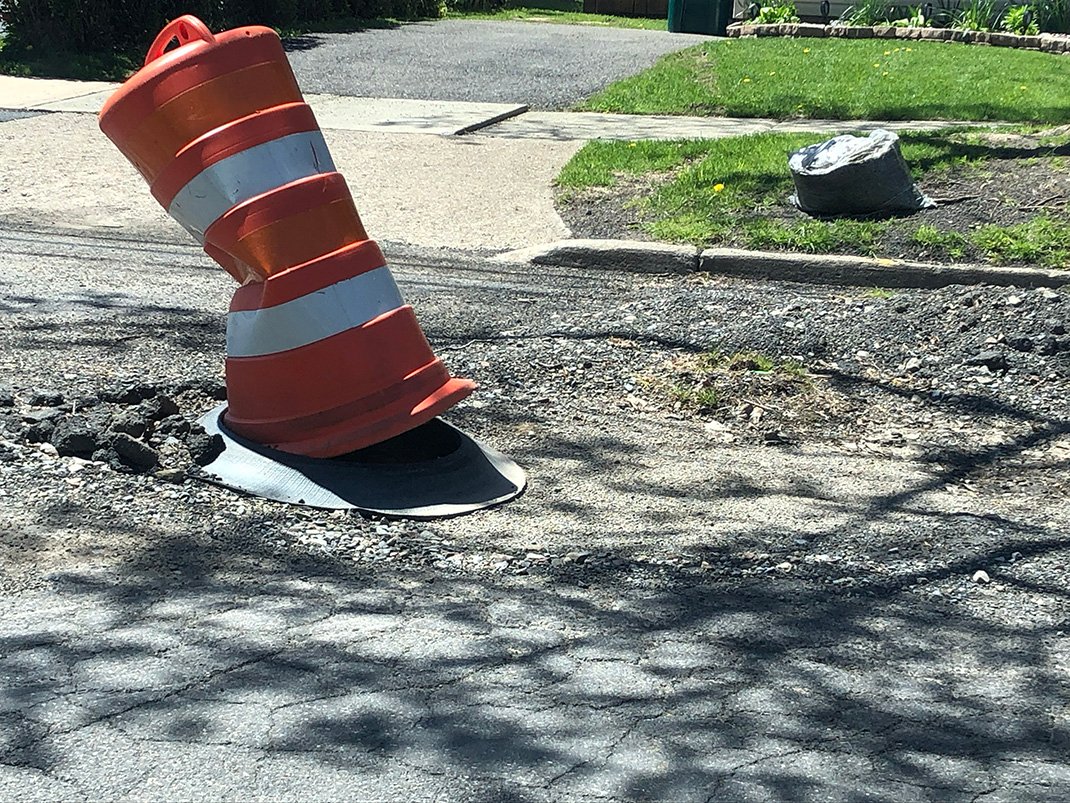
Damage from potholes annually costs drivers a range of $28 billion, according to a 2025 American Automobile Association report
By Tom and Jerry Caraccioli
Following a winter of enduring cold, wind, blizzards, snowbanks, plows, snow tires, snow days and shoveling, local residents always hope Mother Nature and springtime graces them with a fair share of warm temperatures, green grass and flowers.
If only …
While thoughts of swinging a golf club and the beginning stages of blossoms are broken by freak snowstorms in April that cover the ground after weeks of green grass, those daydreams are often brutally shattered by the sound of bang, thump, boom as you drive along some city streets.
Those onomatopoeic sounds aren’t from a Batman comic book. They represent the potential of what was an already gray time of year turning into an expensive and time-consuming one caused by … potholes.
In late-14th century English, the word ‘pot’ was referenced in Scotland and Northern England to describe a deep hole, often linked to a mine or cave. By the first quarter of the 19th century, ‘pothole’ was used in relation to geological formations in glaciers and rocks. It wasn’t until the beginning of the 20th century in 1909 the term evolved into what we know it as today.
And though the word came to fore in the early 1900s, people of that era could never have imagined the stress, anxiety and destruction the meaning of that word induces in the first quarter of the 21st century.
According to a 2025 American Automobile Association report, damage from potholes annually costs drivers a range of $28 billion. An estimated 44 million drivers across the country experience damage and repair bills ranging from $300-$600 for punctured tires, bent wheels, broken suspension components and more. Roughly 1%of all road accidents, with higher risks for motorcyclists and cyclists, are the result of potholes.
 In New York state and cold-weather climates, poor road conditions, potholes and repairs during “pothole season” — mostly springtime — cause damages that average $406 per Empire State driver.
Following the 2026 winter season, Gov. Kathy Hochul announced the New York State Department of Transportation would fix 175,000 potholes across the state.
“Actually, we sell quite a few tires as a result of potholes,” Dallas Mosher, manager of Monro Auto Service and Tire Centers in Oswego said. “We find screws, wheel weights, nails, chunks of metal. We take them out, we dismount the tire and do a pull-through patch from the inside. If the tire can be saved, they have to pay to have the tire remounted and balanced, along with the patch and labor. It can easily cost you $500 for a new tire.”
The formation of potholes consists of three main elements: surface cracks, water and traffic.
In Oswego County, Department of Public Works employees and leaders understand this process as the elements for freeze-thaw weathering.
Freeze-thaw weathering happens when road surfaces crack because of harsh winter conditions that see streets, highways, boulevards and avenues endure months of snow, ice, snowplows, salt and sand. These passageways can’t help but be affected. Roadways made of asphalt become fatigued due to inadequate structure, aging and shrinkage, which leads to poor drainage.
Add water that seeps into the cracks and then re-freezes when the inevitable mid-winter thaw occurs, which is common in Oswego County, as well as daily traffic, and you have a recipe for potholes.
Potholes are the result of this complex interaction of elements in this simply-explained phenomenon.
Oswego County Highway Superintendent Shawn Walker explains some of the issues with potholes while also highlighting the county’s entrepreneurial spirit in solving the problem. His crew repairs 200-300 potholes annually.
“Obviously, the weather is the main factor,” he explained. “But some of it has to do with the blacktop that is used. Oswego County makes its own blacktop. We do our own roads and maintain them.
“Oswego is one of the only municipalities in the state that does that. As a result, our roads are probably some of the best in the state. I don’t care if they’re softball size to basketball size, we’ll patch every hole you see. We do that every spring and normally our roads are good throughout the summer and fall. We have a top-notch blacktop mix plan. I sell it to different townships and municipalities. Cost-wise, I break even.”
Walker takes pride in acknowledging that fact and the hard work he, his staff and the county put into maintaining good roads.
“We get funded every 10 years to pave our roads and never go before 10 years in repaving them. We take pride in taking care of our roads and you can tell that when you drive from our county to other counties,” he said. “Our main goal is to make everyone’s drive through our county as smooth as possible.”
 Tom and Jerry Caraccioli are freelance writers originally from Oswego, who have co-authored three books. They also host a monthly television and multi-platform segment on WSYR-Channel 9 (ABC), “Backroads to Bridge Street with Tom & Jerry.”