

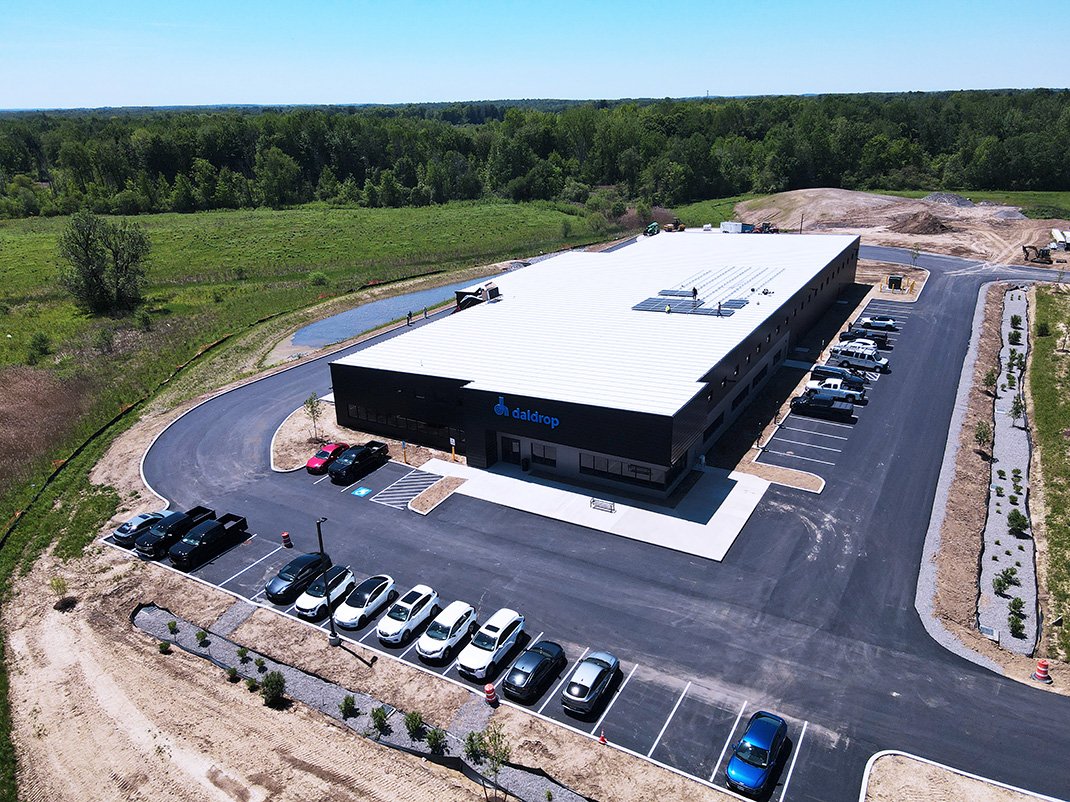
$10 Million Facility in the L. Michael Treadwell Oswego County Industrial Park marks the largest expansion outside of Germany in the company’s 73-year history
By Stefan Yablonski
A new era of cleanroom technology is underway in Central New York.
The Daldrop Group’s advanced manufacturing facility and U.S. headquarters is physically built within the L. Michael Treadwell Oswego County Industrial Park. This industrial park is located in the town of Schroeppel.
It marks the largest expansion outside of Germany in the company’s 73-year history.
Daldrop SBB is based in Neckartailfingen, Germany. It is a global supplier of cleanroom technology, primarily to the pharmaceutical industry. It designs and builds advanced cleanroom environments for the pharmaceutical, biotechnology and medical technology industries.
It nvested $10 million in the new project.
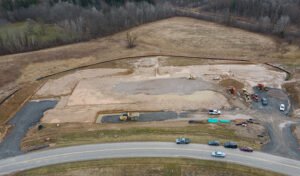
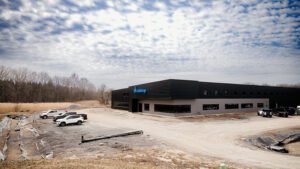
“We broke ground in 2025; we were under construction all winter. We just opened this spring, early spring,” said Benjamin Morrow, operations manager and control. The company consolidated sites in Salina and DeWitt into the industrial park in Schroeppel, Morrow added.
“The next move here is to maximize every square inch of this facility and then we are already looking at the expansion. So, it is more capital investment on equipment — definitely higher-end automation in additional equipment so we can produce more components and then to support the ever-growing base in North America,” Morrow continued. “We are the headquarters for service, maintenance and spare parts. So as Daldrop has more and more installations, they need more and more service, maintenance and spare parts. So that will come out of this facility as well — it already is.”
“As a global leader in GMP (global manufacturing support) pharmaceutical cleanrooms for decades, I am very proud to bring manufacturing jobs to Upstate New York,” said Mike Sullivan, president of Daldrop US operations.
Key to choosing Southern Oswego County
Sullivan said that the selection of the Schroeppel industrial park was mainly due to the help of Operation Oswego County and two people in the organization.
“Prior to being purchased by Daldrop International from the Stuttgart region of Germany, Vince Bongio was a founding partner in SBB Inc. as well as our head of engineering. We based out of Syracuse due to Vince’s skills in HVAC and the manufacturing capabilities found in Syracuse,” said Sullivan.
Bongio moved to Syracuse from California in the 1970s to work in Carrier’s Industrial Division of Large-Scale Petrochemical Refrigeration. Next, he advanced to General Electric’s TV Tube Plant where he got into cleanrooms ,leading to his role of head of engineering for Clestra Cleanrooms where he met Sullivan, their New England distributor.
“Vince Bongio is a phenomenal engineer. Formerly of Carrier, he grew up in California and went to Cal Poly,” Sullivan explained. “Carrier hired him right out of college and he moved to Syracuse. He is the reason we are in Syracuse today. He is retiring this year. We are very proud and his legacy is having brought Daldrop to Syracuse.”
In 2000, Sullivan, Bazinet, Bongio Inc (SBB) was formed with engineering and manufacturing, based in Syracuse, and sales and construction based in Massachusetts as it is today.
“SBB Inc. started in Syracuse. I had a design–build contracting firm out of Massachusetts that was primarily doing all the new technologies coming out of MIT,” Sullivan said. “I started a manufacturing side. A big thing for cleanrooms is the HVAC. Most cleanroom suppliers are architecturally focused people. The strength in Syracuse is HVAC. So, SBB developed with me running sales and construction out of Massachusetts and manufacturing out of Syracuse.”
“Daldrop wanted to have a relationship in the States and of those who approached us, they were the only ones who really understood HVAC. So, we were the right fit for them. We did a joint venture focused out of Massachusetts from 2012 to 2018 leveraging their technologies,” Sullivan explained. “The commitment was if we brought their product to the States, we would do that if they built it here.
“The pieces that had to be in place to make the investment, they wanted to acquire us, we were great with that. If you looked at business recommendations the general guidance was to build in a low labor area — something like North Carolina — but Syracuse had a strong background in HVAC and we chose Syracuse and Oswego County to be our headquarters in the States. So, it is built off of history, technology and the existing supply chain — bringing jobs back to the area.”
During the initial discussions with Daldrop about coming to the U.S., SBB agreed to sell under the conditions Daldrop would manufacture in the U.S. There are many areas that offer incentives and economic packages, but the strength of HVAC expertise and skilled manufacturing was a big part of the discussions for site selection.
Coming home
The second key person to building in Oswego County is Ben Morrow, Sullivan added.
“Ben has been working with Daldrop SBB for more than 12 years and has advanced to COO of manufacturing and engineering. Ben grew up in Phoenix, so building a factory for the Germany company in Phoenix is a strong success for both his community and the appreciation of Ben’s skills as a team leader,” Sullivan said.
“I went to high school in Phoenix. So, this is like full circle for me. It’s a small world,” Morrow said. “I hadn’t been back to Phoenix since graduation. This is one of the properties that John Trimble of C&S, he is the former president of C&S, he just retired, suggested. He and I were very good personal friends. John was from Mexico and I was from Phoenix. We knew each other from high school. And the architect of this building, Ed Smart of smartDESIGN Architecture in Batavia — I went to high school with him. So, this was a project that’s full circle a coming home kind of thing. The three of us knew each other — kind of like it was meant to be. Very serendipitous.”
Schroeppel was one option for Daldrop to consider; the original intent was just to get a warehouse to store some product, he added.
The facility is Daldrop’s largest outside of their native country. Total payroll at the facility will be approximately $2.4 million once fully staffed.
“Here is 32,000 square feet and we plan to expand and put in an additional 10,000 square feet,” Morrow said. “We have 17.5 acres. We can put at least three more facilities here, just on this property. The master plan submitted for the current building is the first of possible three buildings on the campus.”
“If we can find the right people and advance the production according to the plan, we should be able to grow for the next decade. One of the first jobs we filled was our new HR manager, with a primary focus posting and filling new positions,” Sullivan said.
Stop the exodus, start hiring
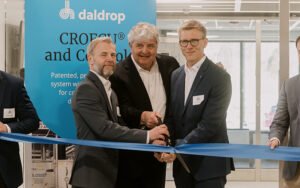
“I have been coming to Syracuse for 30 years. One of the things I had a hard time watching was the exodus of factories. One of the toughest things is to watch it with my partners’ kids who had to move away for jobs. It is important for us to give opportunity where people’s kids don’t have to leave the area to get work,” Sullivan said. “My responsibility is to find people who have skill sets that want to work and then I have to build opportunity for that work to happen.
“After years of watching companies and Vince’s three sons all move out of the areas to get jobs, it is important to us to provide opportunities for the Syracuse region and help grow our company. We have been hiring for our new factory and will continue for the next few years.”
“We are hiring and will continue to hire. Currently we have about 19 on staff right now,” Morrow said. “We expect to grow that by about 10 to 15 in the next 12 to 18 months or so. We are at 19 currently — one in the wings. It’s been great being able to hire locally. All these folks that we’ve been hiring, they all live within a few miles from here.”
“We hired someone this past week (end of August). She grew up in the area, raised a family and is working down in Florida. She just took a job with us so she can move back and be with her family. We will be moving her back and she should be starting in October. We are very happy to see this happen,” Sullivan said. “I feel strongly about having a spot for the kids to not have to move out of the area. It is better to have people moving into the area.”
Currently, Daldrop SBB has openings for finance manager, COO of construction and delivery, as well as mechanical, electrical designers and Revit modelers, construction managers, commissioning agents and many other skills that are needed.
Along with Daldrop’s reputation in life science cleanrooms, there is a strong history in semiconductor, electronics, glass, photonics, aerospace and other markets. This may be helpful with any new technologies building in the market such as the Micron expansion and the support network, Sullivan said.
“We acquired this property and closed on it two months before any announcement from Micron. It is serendipitous that they’re right down the street from us,” Morrow added. “Everybody started thinking ‘you guys are supporting Micron.’ We were here first. That is not a goal of ours. We may or may not … they are talking to us; it is an opportunity.”
The long run
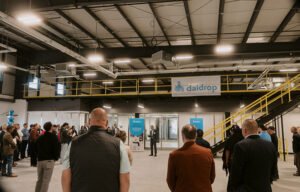
“Long term, we will expand the Phoenix facility,” Sullivan said. “We built our facility with a campus approach. Sustainability is big. We designed our rooms to be more sustainable. Our building has no gas lines for heat. We put geothermal wells in the ground. We put heat pumps in for heating and cooling out of those wells and we put a large layer of solar panels up on the roof. We worked with National Grid for metering. Our building is a high efficiency model. We upgraded all the instillation and the glass filtering. So, it is a very green building. We will have a very minimal carbon footprint. It also adheres to LEED (Leadership in Energy and Environmental Design) construction standards.”
“We are a bunch of HVAC engineers. We did a large scale geothermal and spent the money up front because we knew it made sense in the business sense in the environmental sense and sustainability,” Morrow said. “We have insulated metal panels on walls and roof; we are an envelope from the exterior.”
Daldrop, as a global player, has a strong culture of sustainability that is found in all its products including the new facility. The building has been designed with (sixteen) 400-foot deep geothermal wells, high efficiency construction methods, approximately 70 kilowatt solar photovoltaic panels, electric vehicle chargers and 26% recycled content.
“Daldrop thinks of long-term investing,” Sullivan said.
“On the roof, photovoltaic panels supplement our power. Over half the energy that I use is coming from the sun. We have chargers up front for employee electric vehicles. This place is built to last. This slab that we are walking on, normal buildings are four inches, some go to six inches, we are nine inches all the way through — except where the heavy equipment is — that is 10 to 12 inches thick, solid concrete. It allows us to reconfigure for whatever type of equipment we want to bring in,” Morrow said. “We are authorized by Underwriters Laboratory to self-certify so we don’t need to have an inspector come out and recertify. We get audited often, but we certify our own electronics. The control system in this building is rather high-end. Our thermostat in every room is zoned, independent. We analyze the data; incorporate it with our solar panels.”
“There is a lot of competition for people to work. It’s not just about how much salary they are going to make — it’s about the work environment, the ability for stability. We want to make sure our employees have the best environment to work in,” Morrow added.
Similarities
“One of the reasons I believe why Daldrop chose this area, Phoenix in particular, is because it is a village, a river-based village. Neckartailfingen in Germany where Daldrop is based is also a river-based village, manufacturing community. So, there is a lot of similarities — that smalltown feel,” Morrow said. “We have a lot of connections through multiple employees that lead back to Carrier, also. Everything came together, the timing everything.”
“We are thankful for all the economic development support. Everyone has been helping make this happen. So, keep it up, it is working, that is all I got to say, Sullivan said. “If you look at historical industrial manufacturing, this region has skills that have been un-utilized. The northern industrial region has a lot of skills that if we can tap before they go away, we can leverage them. That is what we are trying to do. You’d be surprised at the supply chain left behind from Carrier — that supply chain is still there.”
“Operation Oswego County has been fantastic,” Morrow added. “I can’t say enough good things about that group.”
What Is Cleanroom Technology
Cleanroom technology is a system of specialized engineering, filtration and operational controls used to maintain an extremely low concentration of airborne particles, microbes and chemical vapors.
How It Works
• Air Filtration: Uses HEPA or ULPA filters to remove 99.97% of tiny particles down to 0.3 microns.
• Airflow Control: Directs air in a steady, unidirectional (laminar) or filtered turbulent pattern to push dust away from work areas.
• Environmental Regulation: Maintains precise control over temperature, humidity and positive air pressure to block outside air leaks.
• Specialized Attire: Requires personnel to wear full-body garments (“bunny suits”), gloves and masks to stop human shedding


