‘We are hanging tough … in an environment that is incredibly difficult to do business in right now,” the port’s director says
By Stefan Yablonski
Tariffs imposed by the Trump administration have hurt the Port of Oswego by slashing Canadian aluminum cargo volumes and reducing revenue.
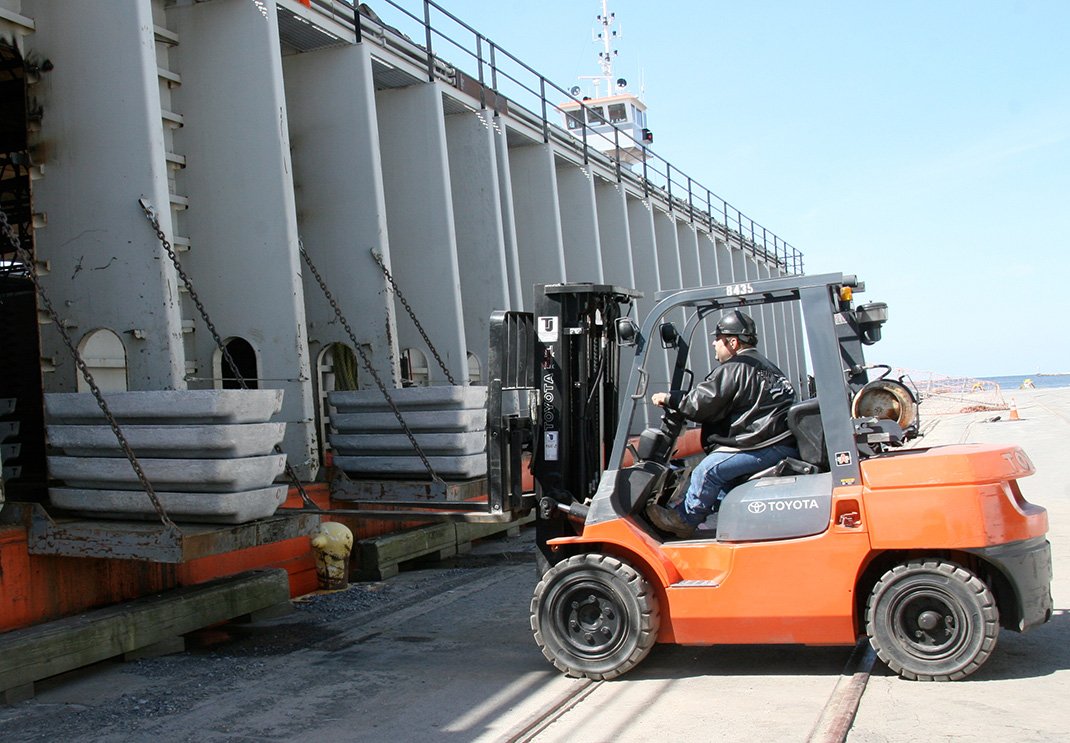
“We’re doing good. We are hanging tough. It is a tough time for our line of business in general, you know with these tariffs and the amount of Canadian aluminum that we see through our docks,” said the new executive director, Tom Drumm. “Compared to 2025, we are doing exceedingly well in traffic coming in; not necessarily the volumes we were seeing, but yeah we are hanging tough in an environment that is incredibly difficult to do business in right now.”
“I don’t know where people get these numbers to be honest. We have never publicly stated how much our revenue is down or up or left to right. We don’t have a strong sense of those revenue numbers until the shipping season really closes up. We won’t have an accurate picture of the revenue standpoint until after the shipping season, typically in late November,” he added. “What I can tell you is several of our Canadian vessels that carry the aluminum cells — the volume of aluminum on those vessels we have seen decreasing. That is attributed to a few factors. One is where Novelis is in in their restart process. Novelis is rocking and rolling right now. They are starting to pull a lot of aluminum from the port of Oswego, the aluminum that they roll down into coils.
“Another factor plainly is the tariffs. Canadian aluminum is tariffed at 50%. So, on those vessels we are seeing lower numbers than we would like. We’d like to see vessels carrying roughly 10,000 metric tons of aluminum. Over the course of this year, we have seen more in the range of 4,000 to 6,000.
“Every piece of that aluminum that we receive here by vessel at the port is from Canada and is subsequently hit with the 50% tariff. It directly affects us because we’ve received less volume than we would traditionally see pre-tariff times.”
When the port receives less aluminum from those vessels it means less hours for the ILA (International Longshoremen Association) as far as folks that work on the dock, he said. When cargo declines, it affects everyone, fewer hours for longshoremen, fewer loads for truck drivers, fewer rail shipments and less business for local suppliers.
“Outside of the aluminum that comes in by vessel, the port topped out at having roughly 4,600 aluminum ingots stored on site at the port. That project had never been done before. The port of Oswego had never had that many of those size ingots in our yard,” he said. “It has been a busy summer for the ILA. Would we like to see more work for them? Sure. They are working all those barges when they come in, but as opposed to working 15 hours they might be working seven or eight hours. It hasn’t been a distinct decline in ILA hours. There has been plenty of work to keep our guys busy throughout the summer.”
More salt
“We just brought salt back to the port in several, several years. Around Harborfest time at one point we had a salt barge here with about 24,000 metric tons of rock salt and we had an aluminum barge here the same week. We had close to 40 men working,” he said. “Yeah, the other products definitely keep us busy. The salt project was a massive project, one that we are proud of. I’ve got 24,000 metric tons of salt on site that has to go somewhere — that’s going to be another project.”
It is important for the port to continue to look at different products, different commodities to try to diversify some of its revenue, he said, adding, “We have done a pretty good job of that in my first five months here … particularly with the rock salt we have on site right now. It is important to continue to try to stand out and work through some projects outside our usual business. I enjoy it. It is a challenge every single day we put our head down and we try our best.”