

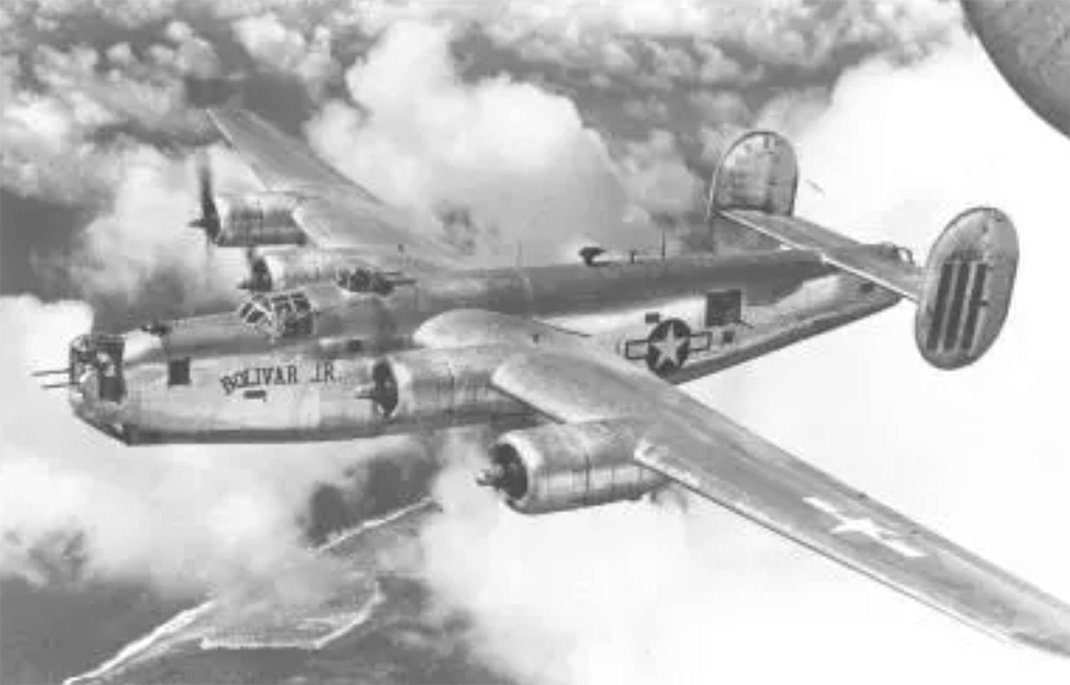
Despite the best efforts of many divers over the years, the B-24 Liberator bomber and its crew of eight have never been found. Is it really at the bottom of Lake Ontario?
By Stefan Yablonski
There are a myriad crafts resting below Lake Ontario’s waves. One of the ghosts that beckons divers to the bottom of the Great Lake is named Getaway Gertie.
On Feb. 18, 1944, Getaway Gertie, a B-24 Liberator bomber, went down during a blinding snowstorm, somewhere between Nine Mile Point east of the Port City and Port Ontario. Experts believe it’s somewhere in relatively deep water. Despite the best efforts of many divers over the years, the plane and its crew of eight have never been found.
According to news reports from the time, Gertie was on a routine training flight from the Army Air Base at Syracuse, a bomber staging area during World War II. A little past 2 a.m. Feb. 18, the bomber radioed its home base at Westover Field, Massachusetts, that it was circling above Syracuse municipal airport. It was reportedly dangerously low on fuel and unable to land due to poor visibility.
According to the calculations of military officials, Gertie could have stayed in the air until 7 a.m. if its fuel was stretched to the utmost.
News reports said radio monitors were keyed to the wavelength of the plane’s radio. But it was never heard from again.
The crew consisted of: Wendell K. Ponder of Jackson, Mississippi, and Raymond A. Bickel of Springfield, Massachusetts, flight officers; Sgt. Audrey H. Alexander of Rogersville, Alabama, Sgt. Kenneth M. Jones of Milwaukee, Sgt. Thomas C. Roberts of Boston, Sgt. Joseph M. Zebo of Pawtucket, Rhode Island, Capt. James O. Cozier of Tulsa, Oklahoma, and Phillip R. Walton of Berkeley, California.
A massive air search got under way. Residents from Rome to the Galloo Island claimed to have heard the loud roar of a plane as it flew low overhead. Oswego and Henderson Harbor Coast Guard officials were alerted. Some reports had placed the plane in the area of the Adirondacks and forest rangers and game protectors were called in to assist with search efforts. The search of the lake proved futile.
Freezing temperatures caused any hole in the ice-covered water to quickly freeze over.
On Feb. 25, Army observation planes from Rome Air Force Base and “flying jeeps” of the Civil Air Patrol spotted a wing panel floating about 700 feet off shore near Pleasant Point, according to news reports. It’s believed that the panel may have “floated for several miles.”
The search lasted for many days. Eventually, the search was terminated. The plane is considered a war relic.
Over the years, several divers’ groups have sought to locate Gertie’s final resting place.
The Oswego Maritime Foundation’s submerged cultural resources program embarked on a search for the B-24 with the help of Tim Shippee and Doug Low, who had built a side-scan sonar, said Phil Church, Oswego County administrator and former director of OMF’s submerged cultural resources program. “They searched an area we designated; but didn’t find the plane. Instead, they located a tugboat called the Cormorant.”
The Oswego Maritime Foundation concluded operations in 2012 when the H. Lee White Maritime Museum at Oswego formally acquired its assets.
In 2000, the search went very high-tech as the U.S. Navy took part. The Kingfisher, one of two minesweepers visiting Oswego as part of the Navy Great Lakes tour of ports, used its equipment to search for Gertie. It ran a search grid adjacent to the area Shippee and Low searched but didn’t locate Gertie, Church said.
“We may find it by finding where it isn’t,” Church quipped.
According to local lore, some people say that Gertie has been found, said William Crist, chairman of the Lake Ontario National Marine Sanctuary advisory committee. “They say we found it, but haven’t released the coordinates of where it is,” he added. “We think it has probably broken up into many places. You can’t say there is one wreck site, one location. That’s a misnomer.”
“If Gertie is in the sanctuary, my personal belief is it has broken up. It will be hard to recognize,” Church agreed.
… But wait, there’s more
Getaway Gertie isn’t the only plane in Lake Ontario. Just four months after Gertie, another crashed.
On Friday, June 23, 1944, a disabled “yellowish brown” airplane, possibly a Canadian training plane, fell into Lake Ontario, near Montario Point, 14 miles northwest of Pulaski, at about 2 p.m., according to information received by the local media.
Reason for believing the plane was a single-engine Canadian Trainer was because of the color markings of yellowish brown, as this type of plane was often seen over Pulaski and vicinity. Later information indicated the plane was gray, with orange markings, having a white star on the tail — it was identified later as a C-47 transport.
According to local news reports: “[T]wo Army airmen, second lieutenants Frederick Frenger of Los Angeles, pilot and Curtiss L. Aultmann of Lynhaven, Florida, co-pilot, had narrow escapes from death Friday afternoon when their big C-47 transport plane crashed and sank in the waters of Lake Ontario about one-half mile west of the Sandy Pond outlet, near the Oswego-Jefferson county line.
“Escaping from the plane and taking to the water before the big ship sank, they were picked up in a motorboat from Green’s Point, Sandy Pond, manned by Mr. and Mrs. Elwin Kast, Milford Tifft, Christine and Faith Sawyer and Clairene Greene, all residents of the vicinity. They had seen the plane crash in the lake and had taken a fast motorboat from Greene’s Point out into the lake where they found the two men swimming toward shore,” the report stated.
A report from the Syracuse airport officials indicated the plane had been on a routine training trip.
A few years later, another plane went into the lake near Rudy’s restaurant.
The five members of the crew bailed out over Rome and left the plane headed toward the lake after it developed engine trouble.
According to The Post-Standard (Friday, Sept. 12, 1952): “Parachute Jump First For 5 Abandoning Plane Which Fell In Ontario.”
The newspaper reported that: “Five men who had never parachuted before told a tale of abandoning a crippled C-45 transport near Utica Wednesday night. Meanwhile, a military search party combed the Oswego area Thursday hunting for the still-missing plane.
“The search was being concentrated in the Oswego area, 65 miles northwest of here, after persons in the region reported that an unidentified two-engined craft plunged into Lake Ontario about 11 p.m., an hour after the five parachuted to earth at Schuyler Corners near Utica. However, Griffiss Air Force Base said it had no reports of any crash elsewhere.”
The plane was en route to Griffiss Air Force Base on a routine training flight from Bedford, Mass., when it developed engine trouble and lost altitude. The pilot, Lt. Col. Charles A. Callahan of Monticello, Miss., ordered the two officers and civilians with him to bale out. He set the ship on automatic control.
“The Good Lord was looking after us,” Col. Callahan told the newspaper. He added that none of the five had ever parachuted before. Jumping at an altitude of 2,500 feet the three Air Force officers and two civilians landed safely.
Other crew members were Lt. Col. Joseph S. Lambert, Newport News, Va., First Lt. Samuel A. Scharff, New York City, William P. Bethke, and Joseph M. Eannarino. The last two are civilian electronics engineers with the Rome Air Development Center and were aboard as part of the training and observation procedure.
Jack Mulcahey and Rudy Gadsalia, original operators of Rudy’s restaurant in Oswego, told the newspaper they saw the plane crash into the lake. Mulcahey said it appeared to be a twin-engined ship and came from the east. He said it circled the area, then dived into the water about a mile off shore and three miles west of Oswego. Officials said they were convinced the plane was the same as that from which the airmen jumped. The time element checked and no other planes were reported missing in the vicinity.
The missing plane had about sufficient fuel left to reach the lake, air force officials said. If the plane did circle over the water as reported, officials said, it could be caused by one motor going dead before the other.
Located
The C-45 aircraft wreck was discovered in Lake Ontario on June 27, 2014, lying deep beneath the water off the coast of Oswego.
The plane crashed into the lake on Sept. 11, 1952, after the left engine failed mid-flight. The pilot ordered all four passengers and the crew to parachute to safety. About 1,000 pounds lighter, the aircraft rose in altitude and altered course, heading out over open water. It traveled (empty) on autopilot for an additional 65 miles before going down in Lake Ontario. After lying undisturbed for 62 years, the wreck was finally located by a team of shipwreck explorers — Jim Kennard, Roger Pawlowski and Roland Stevens — using advanced side-scan sonar equipment. The aircraft remains mostly intact.‑


