

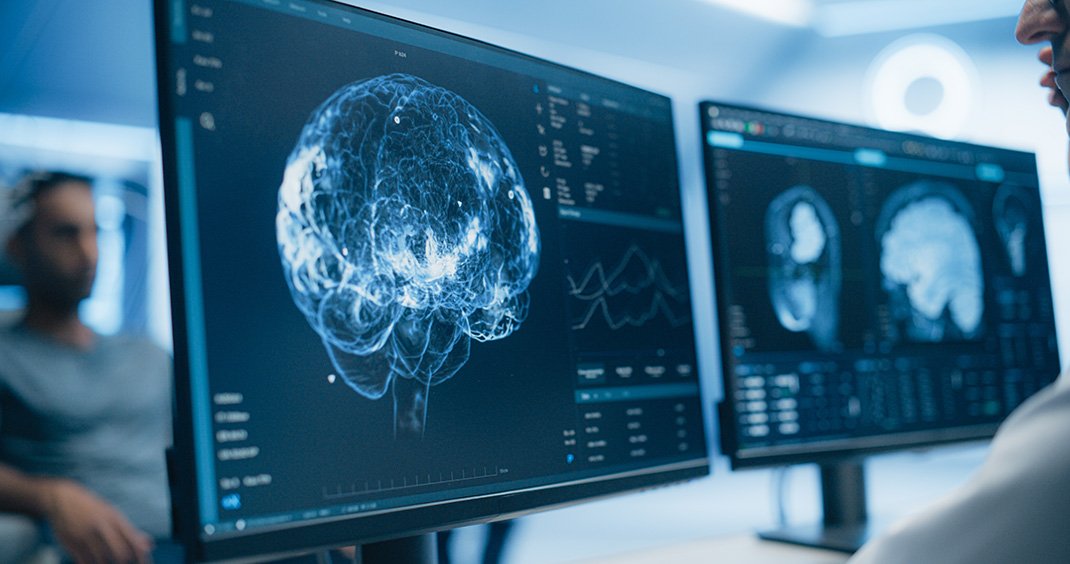
It can detect diseases at an early stage, speed up workflows and allow physicians to spend more time with their patients. However, AI is still learning
By Stefan Yablonski

Artificial intelligence acts as a critical digital co-pilot for radiologists, transforming the way medical images are analyzed and reported. It helps by automating routine administrative tasks and increasing diagnostic precision — ultimately saving clinicians valuable time and reducing physician burnout.
For Oswego Hospital, this technology has been a boon on several levels.
Physician Mohammad Fahad Ali is the hospital’s chief of gastroenterology and hepatology. He’s also the director of endoscopy, director of center for gastroenterology and metabolic diseases and the medical director of digital transformation.
“We’re noticing that some of our bigger challenges are things like rising operational costs, billing, coding — they are taking away time from what we need to do, which is taking care of our patients,” he said. “Waiting times for patients are going up. These are some of the challenges that a lot of healthcare systems across the country are facing. AI is one of the solutions that is offering these powerful tools.”
“The way I look at is that there are two ways in which AI is helping us. One is automation, which is helping us speed administration workflows, improving efficiency and improving productivity. And the other one that I look at is helping us more on the diagnostic aspect in a lot of different aspects. AI is helping us identify, flag and detect disease at an early stage,” he continued. “Also it can instantly analyze massive queues of scans and automatically prioritize those with critical findings or time-sensitive emergencies, getting urgent care to patients faster.
“When you consider specifically Oswego Health, one of the things we have been investing a lot of time in is improving that workflow and reducing the administrative burden for providers. Freeing up time so we can spend more time with our patients. Most radiologists, including our own, are using software that helps them flag early signs and symptoms when it comes to things like breast cancer and lung cancer. It is increasing the speed and accuracy of medical imaging. It is augmenting the work of our clinicians acting as a critical partner.”
The AI boost
AI is boosting diagnostic. Its algorithms serve as a reliable second set of eyes on complex imaging (such as X-rays and mammograms), flagging hard-to-spot tumors or microscopic tissue changes to reduce human error.
AI is fed all the patient data — medical history, etc. “At the end of the day you need a clinician to use kind of like their sixth sense to put it all together,” Ali said.
“Sometimes AI cannot interpret all the information that they are getting. It does have some limitations,” he added. “So, in my opinion you will always need a clinician, a human being, to make sure that it is able to interpret that data and make sure that it is accurate.”
AI is helping physicians, but isn’t able to do it solo and do it in a way that is reliable, the doctor said.
“We still have the responsibility to make sure that the data is reliable and accurate and use our own training to make that final interpretation.” Ali said. “I don’t see AI replacing clinicians. I think AI is going to augment the function of physicians. There was a fear that AI was going to replace radiologists. What we’re finding out is that AI is probably going to increase the demand for radiologists. It’s increasing the productivity of radiology also.”
Reading a scan involves far more than just looking at an image. Radiologists integrate a patient’s age, symptoms, medical history, blood work and prior scans to make a diagnosis, which AI is not yet generalized to do. As AI makes reading standard images faster and more efficient, it lowers the cost of radiology. Consequently, the healthcare system consumes more imaging overall, leading to an increased demand for radiologists rather than a reduction. Until AI is fully able to do the entirety of all the tasks, the job itself won’t go away, according to Ali.
There’s an increased demand for scans, fueled partly by AI tools already approved by the FDA that have made imaging cheaper and faster to produce. All that has also kept radiologists busy, Ali said. Extensive research has been conducted on the role of AI in radiology. The FDA cleared 770 AI medical devices focused on radiology as of 2025 and the body of literature spans clinical trials, systematic reviews and large-scale retrospective studies. Key areas of research include diagnostic interpretation, workflow optimization and report generation, he added.
“The way I look at it is the demand for providers that know how to use these tools and take advantage will be more than someone not well versed in using the AI tools. But I don’t necessarily see AI replacing physicians,” he said. “It’s a very powerful tool that makes us more efficient, more accurate and more productive. A large part of radiology involves hands-on, patient-facing care and communicating complex results.
“At The Center for Gastroenterology & Metabolic Diseases, we have been utilizing TissueCypher an AI-driven tool that analyzes tissue samples obtained during upper endoscopies to predict the five-year risk of progression to esophageal cancer in patients with Barrett’s esophagus, a precancerous condition. In patients with Barrett’s esophagus who undergo upper endoscopies for surveillance, we discuss the use of TissueCypher testing for the purpose of better risk stratification.”
Still learning
“In general, AI relies on large volumes of patient data to learn and make decisions. This increases the risk of data breach and unauthorized access and presents an ethical and operational concern,” Ali said. “Hence, the need for appropriate validation, regulatory review and transparency. We tell our patients that we have a device that is helping us. Transparency is very important.”
Most current AI diagnostic systems don’t inherently explain their decisions in a clinically intuitive way, as the majority rely on deep learning architectures that function as “black boxes.” A systematic review found that only 37% of published diagnostic AI studies in radiology incorporated any form of explainability.
“Since the aforementioned deep learning models used in diagnostic imaging make predictions through millions of learned parameters without transparent reasoning, we’re faced with a significant impediment in clinical settings where accountability and trust are paramount,” Ali said. “However, a rapidly growing field called Explainable AI (XAI) has emerged to address this transparency gap.”
Medical insurers and regulators require a licensed human physician to bear the ultimate legal responsibility and malpractice liability for a diagnosis.
AI is augmenting the roles of clinicians. Even in the case of radiology, physicians (radiologists) are still required to do the bulk of the work — like making final diagnoses, physically examining patients and writing reports, he said.
“It is my job at the end of the day to read those notes from top to bottom to make sure everything is OK and the recommendations are accurate. That is the clinician’s responsibility,” Ali said. “We want to make sure we take the best care of our patients. AI is helping us, but it is not the be-all and end-all. At the end of the day, it is a combination — it augments us, but doesn’t relieve us of those responsibilities.”


