Farms nowadays rely on camera systems to count apples in trees, devices to track the health of animals and meters to measure how often each cow is milked
By Deborah Jeanne Sergeant
More technology is being used on farms than ever. Long gone are the days of simply working hard and hoping for good outcomes. Technology has enabled highly precise agriculture and it’s here to stay.
At Beak & Skiff in Lafayette, Peter Fleckenstein, partner and general manager of fresh fruit and beverages, said that camera systems are helping in the orchards.
“We’ve been trying to find out how many apples are on a block of trees,” he explained. “There is a camera system we can attach to an ATV or truck and we can drive up a row and count the apples on every tree. It can go really fast.”
Previously, relying on cameras or simply walking through the orchards wasn’t as accurate because leaves can hide fruit. However, Fleckenstein said that the latest technology can both see the edge of an apple and include it in the count and can also estimate the size of each fruit, even if some are partially concealed.
“It helps us hire the right number of laborers to pick, know how many empty bins we need in each block of fruit and tell our marketers how much fruit we’ll have for them,” Fleckenstein said.
Using cameras also helps get more accurate harvest estimates than selecting a sample area and then using math to determine figures.
“With the way the weather has been the past four to five years with early frost, heat and thunderstorms, sometimes the fruit on one end of a row looks completely different than the fruit on the other end of the row,” Fleckenstein said.
Beak & Skiff hires Vivid Machines from Toronto for around $1,000 an acre to cover its 200 acres of orchards in June and July to anticipate what the harvest will be in September.
“In general, in produce, costs are rising more than the price returned to the grower so anything we can do to predict and save revenue, we’re doing it,” Fleckenstein said.
At Fouts Farm in Cortland, farmer and owner Paul Fouts relies on several types of technology to help. On the cropping side of the farm, GPS and autosteer helps reduce operator fatigue during the busy season, as well as increase precision for seeding and applying fertilizer.
“We have a lot less overlaps and skips as it’s within an inch of accuracy,” Fouts said. “If you don’t put on enough fertilizer and there’s spaces in between, it starts to affect crop yield and quality.
“We use less fuel and seed. Fewer passes mean less soil compaction and higher yields.”
Driving over the fields too much packs the soil down so that it’s harder for the roots to penetrate and reach nutrients.
On the dairy side of the operation, the farm uses an ear tag that functions as an activity monitoring system to track movement, eating and resting 24/7. Fouts can detect sick animals faster so that they’re treated sooner, minimizing animal suffering and preventing the spread of illness. In addition, since milk from sick cows does not enter the bulk tank, it’s ideal to keep the herd healthy to reduce wasting milk.
Meters in the milking parlor tracks when each cow is milked, how many hours they’re milked and if the equipment is leaking air.
Technology can also help with cow comfort measures. Relaxed, comfortable cows live longer and give more milk. Since they tend to run hot, keeping them cool in the summertime is important.
“Some of the curtains on the barn are automatic so they’ll open and close on their own depending on temperature,” said Julia Fouts. “We have sprinklers in the barn that do the same. It’s more accurate that way too.”
The animals’ feeding system is also computerized so that the farm can easily and accurately follow their nutritionist’s advice and provide optimal rations for the cows at each stage of their lives.
“Every farm has to look at their unique situation and see what they’ll make use of,” Fouts said. “There’s no need to spend money on the technology if you won’t use it.”
Some farms use robotic systems for milking, pushing feed and scraping waste from the floor. Fouts doesn’t use any of these. But he feels the technology he does use “enhances that care and it can give you more information so you know more about what’s going on and you can farm better.”
The farm milks 625 cows and raises 1,100 acres of corn and hay.
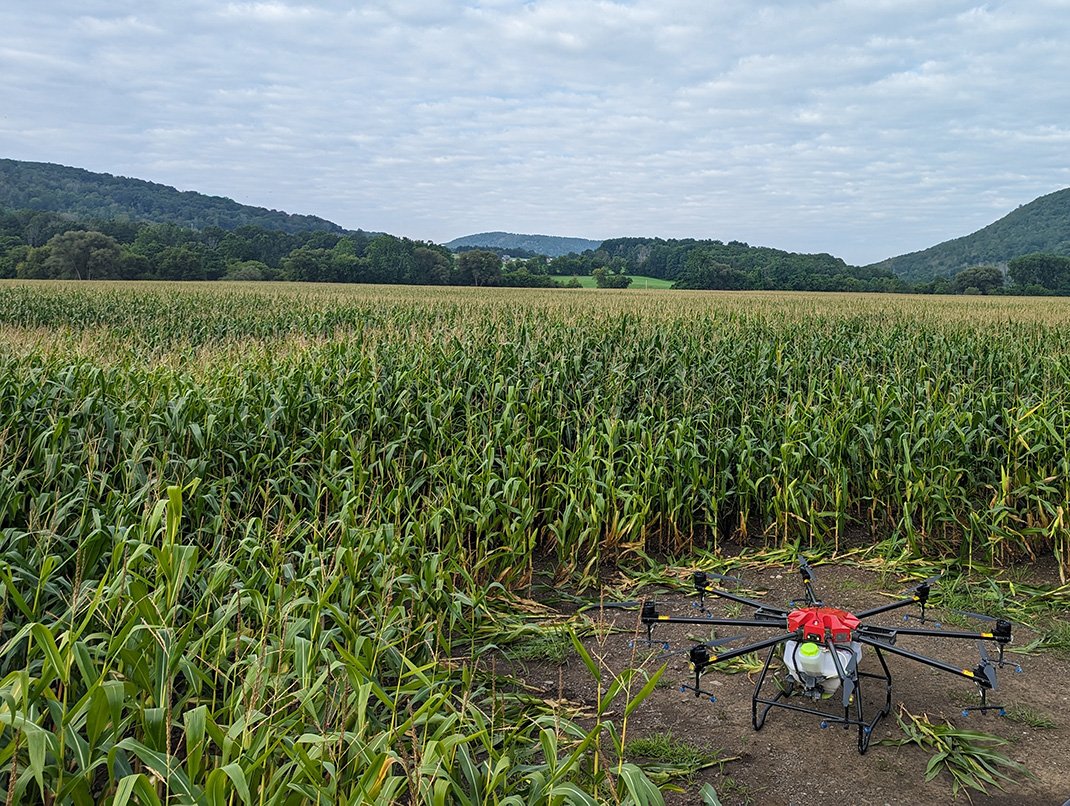
Rick Jordan, operations manager at CNY Drone Services in Clinton, offers farmers options that can help them oversee their fields efficiently and reduce soil compaction. CNY Drone can map, plant, spray and scout fields, all without placing a wheel on the dirt.
“We use multisensorial spectral to see the overall health level of the plant,” Jordan said. “It goes down to the cellular level. For row crops, you can scan fields and detect how healthy certain areas are. We can do a prescription map with variable rate applications. We can provide that to the customer to load in their own sprayers or we can do it as well with our drones.”
This kind of planning can help farmers reduce their overhead by not wasting spray or fertilizer.
Jordan can also perform thermal analysis which can be useful to determine which spots are coming up cooler on the map to look at water logging. AI assisted mapping can determine where that drainage will go in a particular field.
Soon, he hopes to introduce ground-penetrating radar to determine levels of compaction in a field, depth of compaction and if old tiling in the field is causing issues.
He also sprays for invasive aquatic weeds more effectively than boat-based systems that disrupt the water and thereby spread the weeds.
Jordan also uses whitewash type of paint to spray the tops of industrial-sized greenhouses in the summer to provide much-needed shade. What takes people weeks to do while walking on panes of glass takes the drones just hours. The drones remove the paint in the fall.
“Labor savings alone is one of the big driving factors,” Jordan said. “These are five acres per greenhouse and 30 acres total in greenhouses.”
Janet Thomas Oppedisano, agriculture and food systems program leader for Cornell Cooperative Extension Onondaga County, said that time savings is a big motivator for farmers who use technology, along with “helping them maintain their business records but also help them forecast and plan for the future. There’s a combination of technology integration that will become more commonplace. It’s not just ‘on the farm’ but farm to supply chain. Supply chains are maintaining food safety records and getting food distributed across very wide spaces. It’s easier through technology to trace food. It can still be maintained as safe with tracker tags.”
She thinks that forecasting will become an even bigger part of farm-based technology as that will help farmers plan better.