

A new nuclear power plant would greatly benefit a region … but who will ultimately get the site?
By Stefan Yablonski
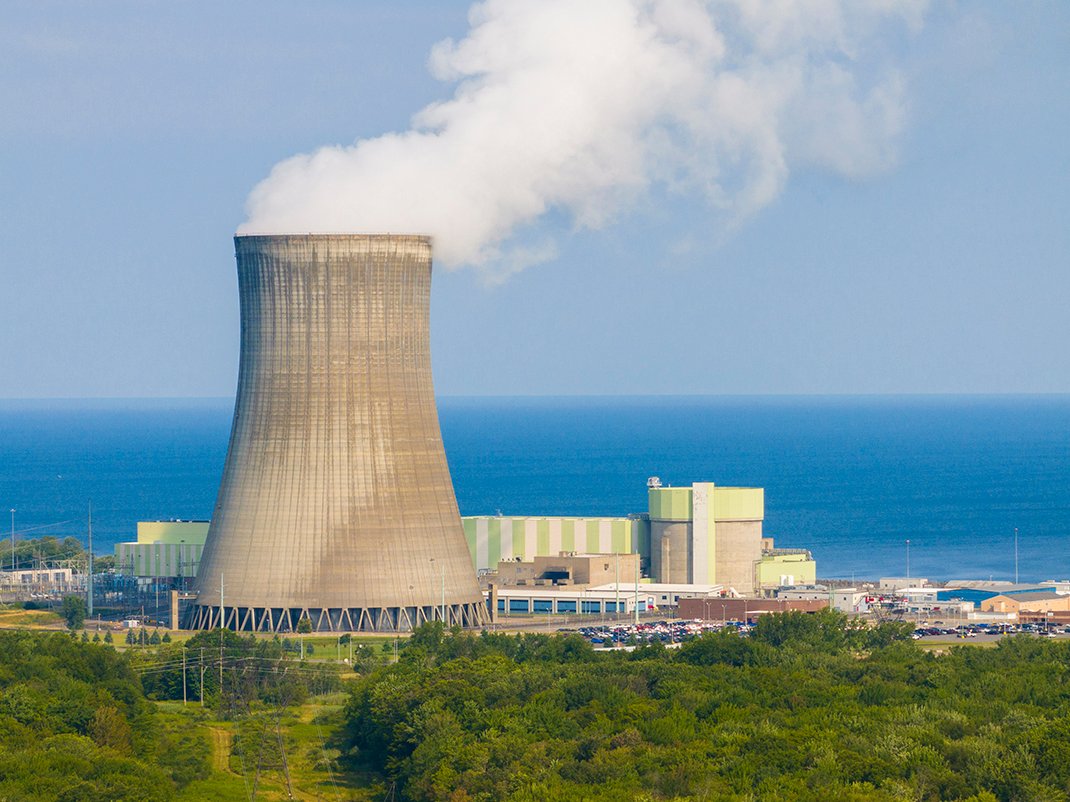
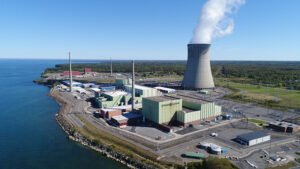
Oswego County is a major U.S. nuclear power hub, hosting three reactors on Lake Ontario in Scriba. It is eyeing the possibility of hosting a fourth. Several other places are as well.
Nine Mile Point Unit 1 (1969) is the nation’s oldest operating plant. Together with Nine Mile Point 2 (1988) and James A. FitzPatrick (1975), they provide significant baseload, carbon-free energy.
Now operated by Constellation Energy, the plants are central to New York’s clean energy goals.
“Constellation’s three Upstate New York nuclear facilities deliver nearly half of the state’s emissions-free power, support 14,400 local jobs and deliver millions in local tax revenue, all of which provide a solid foundation for new nuclear projects to build upon,” said Rich Barlette, Constellation’s director, state government affairs. “These existing sites that have longstanding and strong community relationships would serve as ideal locations to site new nuclear projects in New York state.”
In 2025, Gov. Kathy Hochul directed the New York Power Authority to build a zero-emission advanced nuclear power plant “to support a reliable and affordable electric grid, while providing the necessary zero-emission electricity to achieve a clean energy economy.”
As part of New York’s pledge to create a zero-emission electric grid, Gov. Hochul is calling for as much as 4 gigawatts of new advanced nuclear power in the state. That would be added on top of New York’s three current plants and a previously announced 1 gigawatt New York Power Authority project, creating part of an 8.4 gigawatt “nuclear backbone” for the grid. One gigawatt is enough to power about one million homes.
Hochul made the announcement during her 2026 State of the State Address with the goal of providing steady, around-the-clock power that can back up wind and solar.
Large projects in New York, like Micron’s planned $100 billion chip site in Clay, will need huge amounts of reliable power. So will any future data centers and advanced manufacturing facilities, according to the governor.
There is a huge re-industrialization going on in New York, said Gov. Hochul. To that end, New York needs on-demand energy. If New York wants to stay competitive in an industrialized world, it needs to provide energy to industrial consumers. To power New York’s future, three things are needed: reliability, affordability and sustainability — and nuclear drives all three, according to the governor.
Nuclear power supplies about 21% of New York’s electricity.
In January 2025, Constellation and NYSERDA applied for US Department of Energy Grant funding to support development efforts on an “early site permit” for a potential project at Nine Mile Point with the Nuclear Regulatory Commission, Barlette said.
“We are still awaiting a response from DOE on this,” he added recently.
“NYPA is quickly advancing efforts to develop an advanced nuclear project in Upstate New York that will strengthen the reliability and resiliency of our state’s electric grid and deliver substantial economic benefits to residents,” New York Power Authority President and CEO Justin E. Driscoll said in a prepared statement. “The enthusiastic response to the Power Authority’s first round of solicitations reflects a strong desire from communities and collaborators that are ready and willing to help us lead New York into its clean energy future.”
“There really is nothing new to report. NYPA came out with a request for information. The next step is request for proposals,” said Assemblyman Will Barclay.
“With 60 years of experience as a nuclear host community, Oswego County is ready for the addition of new nuclear facilities,” Phil Church, county administrator said. “We already have a qualified nuclear workforce, skilled trades workers, safety infrastructure, nearby electricity demand and a supportive community. Nine Mile Point has abundant land available for nuclear construction.”
The reactors provide hundreds of jobs and millions in tax revenue.
“As the largest nuclear operator in the US, we feel the best place to build a nuclear plant is adjacent to existing ones. We currently operate four units across three sites — FitzPatrick facility and the Nine Mile facilities in Oswego [County] and then we have the Ginna facility up outside of Rochester. All four of the plants produce half of New York state’s clean electricity,” Barlette said. “It is our position that if you are serious about the climate and the goals of New York state you need every clean resource at your disposal.”
“The building of this power plant would be a county scope obviously and more regional into some of the surrounding counties,” according to Elizabeth Schmitt, a professor of economics at SUNY Oswego. She joined the faculty in 1995.
“There is the construction phase, which will be huge, then there would be the operations phase — continued jobs, hired by the power plant, local goods and services,” she added. “Indirect impacts will ripple through the supply chain. For the scale of this production, you would bring in workers from all over.
“Oswego was a boomtown when the other nuclear plants were being constructed. This would be the same thing. They would bring money into the economy — housing, going out to eat and all these other things — there is a significant impact of that. And then the continued employment.”
It is about an eight- to 10-year process to get a plant online, according to Barlette.
Competition
Oswego County is facing a lot of competition for the plant.
“It’s an ongoing process. We don’t really have any information to share at this point,” said Alex Chiaravalle, New York Power Authority, media relations. “We issued solicitation for potential hosts, a RFI [request for information]. We did get robust intertest. There were eight responses for interested communities — Oswego County was one of them.”
In addition to the intense interest from Oswego County, several other counties, cities and private entities in Central New York and surrounding upstate areas are actively seeking to host new nuclear power plants, driven by Gov. Hochul’s push for 5 gigawatts of new nuclear energy to support the state’s grid.
As of March, the following entities have expressed interest in hosting a new nuclear facility in response to the New York Power Authority Communities RFI:
• Oswego County: The primary candidate, already home to three operating reactors, has submitted formal interest to NYPA and is strongly supported by local labor and business leaders to host additional reactors.
• City of Dunkirk: Actively lobbying to host a new reactor on the site of a former coal-fired power plant.
• Broome County: Expressed interest in hosting a project.
• Jefferson County: Actively pushing for involvement, supported by local state representatives.
• St. Lawrence County: Identified as a potential host community.
• Schuyler County: Has expressed interest, though discussions are ongoing regarding site requirements.
• Wayne County: Expressed interest, noting its existing infrastructure.
• RED-Rochester: Manages energy at Eastman Business Park, near the existing Ginna nuclear station and has expressed interest.
In a second RFI, the power authority sought information from potential development partners regarding viable project concepts that included technology recommendations, siting considerations, cost and timeline assumptions, ownership structures and partnership models.
Constellation did submit a response to NYPA’s development partners RFI. Oswego County submitted a response to NYPA’s host community RFI, according to Mark Rodgers, Constellation spokesman.
“I believe we got 23 responses for that RFI. It’s very early on. We are just trying to get as much information as we can,” NYPA’s Chiaravalle said. “If a community or a potential development partner didn’t respond, it doesn’t preclude them from responding from future solicitations that we might issue.”
“Right now, we are just reviewing all those responses and getting all the information to help guide our efforts in 2026,” Chiaravalle added. “There is no deadline. We are trying to move as quickly and expeditiously as possible. Gov. Hochul sees nuclear as being the backbone of the state’s electric supplies. We are moving as quickly as we can. But right now, we are still pretty early in the process. We announced in June of last year. So, it hasn’t been a year since the launch of our efforts.”
Separately, NYPA will provide $40 million in annual funding over the next four years to help develop the skilled workforce needed to support advanced nuclear energy in New York state, he said.
As exciting as this is, New York is in the very early and preliminary stages of this initiative. Don’t expect detailed project plans at this stage or anything like that, Rodgers added.
“Of the alternative energies, nuclear power tends to have a higher employment. Wind farms just don’t need a lot of people to operate them. Same with the solar farm,” Schmitt, the SUNY Oswego economic professor, said. “So nuclear tends to have more sustained employment. There would be a huge impact for the construction phase; but it would still continue in the operations phase. And with the power plant just being here, it could boost employment in some other industries because it brings more people here.”
What does New York’s nuclear push mean for construction?
For the construction industry, this could mean more business, according to ConstructConnect.com, which provides data and software to help contractors and manufacturers find, bid and win the right construction jobs. Advanced reactors are being pitched as smaller and easier to site than older plants, opening a wider range of locations where they could be built.
Construction and operation of new advanced nuclear plants would bring very positive economic benefits to Oswego County and the region, County Administrator Church agreed.
“Construction would create thousands of good-paying jobs for the trades and with that would come increased spending activity in local businesses,” he said. “Operation requires hundreds of high-paying permanent jobs. The three plants we currently have support more than 1,400 direct jobs and 14,000 indirect jobs in the region. The increased power supply could also attract new industry to locate here.”
High value properties such as nuclear power generators also improve the tax base, which will help fund government services and lower property tax bills.
The three plants currently pay $48.8 million annually through tax agreements to the county, Scriba and the Oswego and Mexico school districts, Church added.
Whether it is going to be a private developer or a public entity would make a big difference for the tax base, according to Schmitt.
“Any power plant that gets built will have some sort of PILOT agreement. Even with a PILOT, there is going to be payments made for services. It will benefit the school districts as well,” she added.
“The economic impact and cost would really come down to the type of technology chosen, the size and how many. But based on other investments happening around the US, an advanced nuclear plant would have a $10+ billion-dollar investment at the low end,” said Austin M. Wheelock, executive director, Operation Oswego County, Inc. “A project would employ thousands of construction workers for approximately five years and hundreds to potentially thousands of permanent employees.”
“Nuclear New York celebrates Gov. Kathy Hochul’s unprecedented commitment to advanced nuclear energy as a cornerstone of New York’s clean energy future.” It said on its website. “By setting a goal of five gigawatts of new nuclear, the governor has embraced the strategic framework that positions New York to lead the nation in cost-effective, programmatic nuclear deployment.
“This announcement represents a fundamental evolution in New York’s approach to nuclear energy. Rather than viewing advanced nuclear as individual, standalone projects, the state is now pursuing the proven strategy that brought costs down dramatically in South Korea France and other successful nuclear programs: standardized, sequential deployment with committed orderbooks (the total dollar value or quantity of assets that have been pledged toward pending buy or sell orders that have not yet been executed).”
Nuclear New York Independent advocates for reliable carbon-free energy (NuclearNY.org)
Other benefits
Aside from an increase in construction jobs, there would be secondary benefits from having a fourth nuclear plant in Oswego County, Schmitt pointed out.
“Workforce development effects a better educated workforce. And the project can drive infrastructure improvements. Just look at Micron. Now you finally have to widen [Route] 31. All those improvements are going to benefit all the drivers in the area not just the company itself,” she said. “Also, improvements in the extension of sewer lines, extension or improvements of water lines as well, which is something that is always sorely needed in Oswego, right?”
“Nuclear is reliable base power. It doesn’t fluctuate and is very attractive for certain industries. So now you are going to have a location which can deliver that power and an abundance of fresh water. That is very attractive. Look a little bit long term. We’ve got fresh water and a lot of areas in the country that are booming now that do not have enough water to sustain the greater growth. It makes us a really attractive location. If we get this and you are building Micron at the same time, good luck if you need an electrician. It’s going to be an interesting time for the trades. For those who don’t think college is for them, maybe they should learn a trade. This will help keep younger people here. There is a logical synergy between Micron and a power plant.
“Some data centers are big power users. Once you build it, they don’t employ a lot of people. They come and they use power, they use water. But they don’t really contribute to the local economy. A nuclear power plant both in the construction phase and later in the operations phase make a sustained contribution.”
“Nuclear is the only clean technology that runs 24/7 and 365. The only time it shuts off is when it shuts down to refuel, usually once every two years for a couple weeks. Others are intermittent. Nuclear is the only one that runs 24 / 7 and can be clean at the same time,” Barlette said.
“The [Oswego] county legislature approved some funding to do some lobbying here in Albany. We are going to continue to raise awareness of it,” Barclay said. “I still feel pretty good about it. Every conversation I have had with anybody Oswego County is always mentioned as the best potential site. With all the construction jobs and permanent jobs, this area would be a boomtown again. I’m pretty optimistic.”
“We will see what comes of this ultimately. We have a longstanding partnership with the state of New York in helping them hit their climate goals,” Barlette said. “We are certainly encouraged that they are looking at new nuclear. It means jobs, tax revenues, clean energy and reliability too. It is a firm resource that runs 24 /7 365.”
A Timeline of Nuclear Power Generation in Oswego County
In July 1963 Niagara Mohawk announced plans to build a nuclear power plant at Nine Mile Point in Scriba, Oswego County. Construction began on Nine Mile Point Unit 1 in 1965.
A controlled nuclear reaction was produced for the first time at Nine Mile Point in September of 1969. Electricity was made for the first time at the Nine Mile Point 1 plant in November 1969. A month later Nine Mile Point 1 began commercial operation and provides electricity to customers throughout the region.
Nine Mile Unit 1 is recognized as the oldest operating commercial reactor in the U.S., with a license extending to 2029.
• The James A. FitzPatrick Nuclear Power Plant — named after Power Authority Chairman James A. FitzPatrick — is located in Scriba, on the southeast shore of Lake Ontario. The 900-acre site is also the location of two other units at the Nine Mile Point Nuclear Generating Station.
• The plant has one General Electric boiling water reactor.
A construction permit was issued for the FitzPatrick plant on May 20, 1970. Construction began later that year. Five years later, on July 28, 1975, commercial power production began at FitzPatrick.
Originally owned by the New York Power Authority, it was sold to Entergy in 2000 and finally to Exelon (now Constellation) in 2017.
• A construction permit was issued for Nine Mile Point 2 nuclear plant in 1974 and construction started in 1975. It wasn’t until March of 1988 that Nine Mile Point 2 began commercial operation.
• It is the largest reactor in New York and is licensed to operate until Oct. 31, 2046.
Both units 1 and 2 are General Electric boiling water reactors. Unit 1, a BWR-2 (Generation 2), has a rated capacity of 644 megawatts. Unit 2, a BWR-5, has a rated capacity of 1,375 megawatts
• November 2001: Constellation Energy buys 100% of Nine Mile Point 1 and 82% of Nine Mile Point 2.
Originally, these plants were built by Niagara Mohawk and the New York Power Authority. Following financial struggles in the 1990s, the units were sold to private entities. Constellation Energy (formerly Exelon/Entergy) currently owns all three.
All three units use dry cask storage for spent fuel, with licenses for extended operation.
• In April 2011, Exelon of Chicago announced its intention to purchase Constellation Energy, the owner and operator of Nine Mile Point Nuclear Station. The acquisition was approved by FERC and the companies officially combined on March 12, 2012, with Constellation Energy taking the Exelon name.
• Exelon separated its generating assets back into Constellation Energy in 2022. Constellation owns unit 1 and holds 82% of unit 2 while Long Island Power Authority holds 18%.
• Constellation Energy is the sole operator of both units 1 and 2.
Unit 2 is the only reactor in New York that has a cooling tower. The cooling tower is 543 feet tall.
Unit 1 draws cooling water from Lake Ontario and doesn’t have a cooling tower.
• On Nov. 2, 2015, Entergy announced its plans to shut down FitzPatrick at the time of its next fuel change in 2016 — because it is becoming too costly to operate. However, they instead elected to sell the plant to Exelon Generation for $110 million. In August 2016, Exelon agreed to buy the plant pending regulatory approval and formally acquired ownership and operation on March 31, 2017.
• In April 1, 2017, Exelon’s generation division, Constellation Energy, assumed ownership and continues to operate the plant.
• New York State Energy Research and Development Authority and the U.S. Department of Energy funded a demonstration project at Nine Mile Point — became the nation’s first nuclear-powered clean hydrogen production facility in 2023.
• At their peak, New York’s reactors provided a combined 5.4 GW of capacity and generated one third of the state’s grid electricity.


