


He is one of eight New York state hoof-trimmers listed on the website of the Hoof Trimmer Association. He grosses $6K to $8K a month
By John Addyman
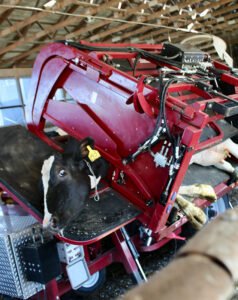
Cow 143 was a little hesitant. She didn’t like getting into the chute. Wendall Reiff, her hoof-trimmer, gave her a couple of slaps on the rump to urge her on.
Cow 143 didn’t know it was the day for her pedicure. As she got into Reiff’s machine, suddenly the sides closed in on her, gently but firmly immobilizing her.
And then, the whole thing tilted. Cow 143 was watching her world from an angle she hadn’t been in before.
“What the heck is going on?” she must have asked. Her eyes were wide.
Reiff went straight to work, his circular saw slicing away about half an inch of the bottom of her hoof. He bore down as chunks of hoof flew into his facemask and over his head. The machine holding her firmly. A Tuffy Tables Professional Hoof-trimming Machine, made sure she couldn’t make a movement to interfere or disrupt the process.
In six minutes, the Aurora resident was done. All four hooves looked great, the machine set Cow 143 upright again and out the other end of the chute she went. She was about the 12th cow he’d worked on that morning and he had 50 more to go.
It was a busy day.
As gently as the machine treats the cows, they’re not all happy with the experience. “Some of the older cows, if they’ve never had an issue going through the chute, if it never hurt them, they never had pain going through the chute, they know what’s coming, they don’t have a problem, they’ll go in and stand there, waiting for me,” Reiff explained. “The ones that have had a problem, they don’t like it so much.”
Reiff, just 19 and a graduate of Cayuga Mennonite School, is in his first full year of hoof-trimming.
He learned the skills through years of helping his uncle, Lavern, who decided to get out of the business late last year and wondered if young Wendall would like to take it over. Reiff had been spending most of his time on fence-building crews and he still does that as a sideline, but now he’s a hoof-trimmer, pulling the Tuffy Tables machine to each of his 50-some customers behind a pickup truck.
“Most of my clients are people my uncle Lavern and I trimmed for,” he said. “I really don’t advertise; business comes to me mostly word-of-mouth.”
He is one of eight New York state hoof-trimmers listed on the website of the Hoof Trimmer Association.
He’s working as a sole proprietorship at dairy farms as far west as Phelps, north to Sodus, east to Aurora, where he lives and south to Penn Yan. Hand him a cow and $12 and he’ll trim.
Cows need their hoofs evened out and cut back twice a year, that’s the trimming.
It’s done to keep the cows healthy and happy.
“I can do about 10 cows an hour; some take a little more time, some take less. It varies by cow. How long has it been since they were last trimmed? Have they been standing in a stall for a long time? When they’ve been standing in a stall all the time, their hoofs are very hard. I cut that back until what you see is a hoof that’s all white and smooth,” he said.
He knows he’s helping keep cows happier and pain-free.
“You watch them walk in and you can see they’re uncomfortable walking. After the trimming, they walk out and their feet are straight and their legs are straight. No more are their toes pointed up in the air or they’re legs turned out because they’re uncomfortable,” he said.
Gross income: $6K-$8K a month
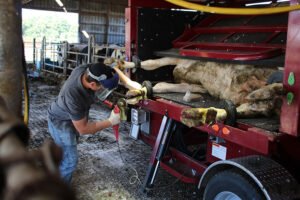
When Reiff started to learn the hoof-trimming ropes, he was a helper for his uncle, moving cows toward the chute and registering the number of each cow that was trimmed and leaving notes for the farmer about conditions that might require more treatment.
“I’m not a vet,” Reiff said, adding that he can alleviate some conditions like hoof rot, but treatment had to follow that, which would be provided by the farmer or vet.
For a lame cow, he is able to provide some relief: he glues a special pad on the good claw (cow hooves have two claws) to take pressure off the injured claw.
“If everything’s been done right” for a cow after trimming, “they’ll have their legs straight under them. The back legs will have their knees together,” he said. That’s a happy cow.
Getting himself set up in business required assistance from the Cayuga Lake National Bank. That Tuffy Tables Trimming Chute is a $70,000 piece of equipment. Reiff’s expenses include maintenance and upkeep on the machine, his tools, transportation to job sites, the pickup truck and supplies. His gross income is about $6,000 – $8,000 a month.
“I’m not quite full-time yet,” he said, “But I have a solid customer base.”
If a farmer has 120 cows, he’s there four times a year; if the farmer has 200-300 cows, he’s there once a month.
He still works some days on fencing crews, but the hoof-trimming business is growing.
“I started getting serious about learning about hoof-trimming a year ago. I started out working two days a week in February. My uncle wasn’t going to expand to more farms. He had his own dairy business to run,” he said.
Reiff took some classes and workshops at the Cornell Cooperative Extension but felt the most important training was working hand-in-hand with his uncle.
“I think the best way to get started, the best option, is finding someone who does this and having them train you,” he said. “Most of what I learned I learned from my uncle. The Cornell workshops were also good.”
On site, he works alone, maneuvering cows, making notes for the farmer and trimming the hooves. He’s always in motion and his process is professional and workmanlike.
And when he drives home in the afternoon, the cows are all smiling.


