By Mary Beth Roach
 OLD FORT NIAGARA LIGHTHOUSE
102 Morrow Plaza, Youngstown, NY 14174
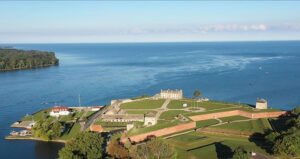
The original Fort Niagara Lighthouse was situated at the top of the “French Castle” at the fort in 1781 by the British during the Revolutionary War, according to Fort Niagara executive director Bob Emerson, it was the first light on the Great Lakes. While the castle is still there and the fort is celebrating its 300th anniversary this year, that original lighthouse is gone. In the 1800s, the structure was in poor condition and troops living at the castle complained that the lightkeeper had to keep going through their barracks to service the lamp, Emerson said, so a new lighthouse was built. This structure was decommissioned in 1993 and its Fresnel lens is on display at the fort’s visitor’s center.
Tours of the lighthouse are available, although Emerson said it has a limited capacity. There are volunteers at the entrance and at the top. Once at the top, there are great views of the Niagara River and Lake Ontario.
THIRTY MILE POINT LIGHTHOUSE
Part of Golden Hill State Park, 9691 Lower Lake Road, Barker, NY 14012
The lighthouse, situated in Golden Hill State Park, guided ships beginning in 1876.
Decommissioned as an active navigational aid in 1958, the lighthouse, which once served as quarters for the keepers and assistant keeper’s families, can now serve as guests’ quarters for week-long stays during the summer or shorter stays during the rest of the year.
The lighthouse cottage is available for rent through the Reserve America website (https://tinyurl.com/mrr2ntec). Among the amenities listed are a private entrance, a kitchen with refrigerator, electric stove, microwave, coffee maker, cooking utensils, silverware and dishes, living room with electric fireplace for a cozy feeling, full bath with an old-fashioned bathtub, three bedrooms with queen size beds and pillows and a beautiful view of Lake Ontario that is stunning. Access to the lake allows for some great sportfishing opportunities.
Unlike the other lighthouses along the Lake, this one was not built to guide mariners to safety, since its location is remote and some distance from any major port or city. Instead, it was constructed as a coastal light to warn ships and boats away from the shoals and given that name since it is 30 miles east from the mouth of the Niagara River.
History tells us that prior to it being built, at least four ships had sunk near the Thirty Mile Point, the most tragic being that of the H.M.S. Ontario. Built during the Revolutionary War, it was the largest British warship on the Great Lakes at that time.
A few short months after its launch, the Ontario left Fort Niagara for Montreal, with 88 passengers, including the commander of the fort, along with the army payroll and $15,000 in silver and gold. It sank off Thirty Mile Point during a Halloween storm and there were no survivors.
Chosen to represent Lake Ontario by the U.S. Post Office, it was featured in a set of stamps issued in 1995 that featured lighthouses of the Great Lakes.
OAK ORCHARD LIGHTHOUSE
14357 Ontario St., Kent, NY 14477
Visitors to the lighthouse, at Oak Orchard River at Point Breeze, are actually seeing a replica of the original, which was constructed in 1837. By the early 1900s, the U.S. Government had abandoned the lighthouse and a storm in 1916 destroyed the building.
Although the lighthouse was gone, the Oak Orchard Harbor remained quite active. During Prohibition, it’s been told that bootleg Canadian whiskey was brought into the harbor and from the 1930s to the 1950s, snipe racing was popular there.
In the 1970s, the U.S. Army Corps of Engineers built new piers and a breakwall and in the early 2000s, a devoted group of area residents formed the Oak Orchard Lighthouse Committee. Through their diligent efforts an historically accurate replica of the original lighthouse was constructed and opened to the public in 2010.
Tours, which are $20, include access to the tower and a museum, featuring historic photos and video.
 CHARLOTTE-GENESEE LIGHTHOUSE
70 Lighthouse St., Rochester, NY 14612
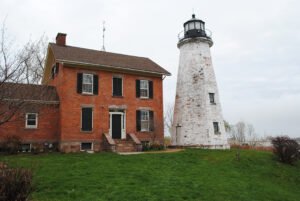
One of the oldest lighthouses on Lake Ontario, the Charlotte-Genesee Lighthouse was built in 1822. Today, the grounds include the 40-foot tower, capped by a 12-foot-high lantern room; the former lighthouse keeper’s home, with three separate rooms focusing on marine history, the lighthouse and Ontario Beach Park. On the grounds, too, is the International Peace Garden, with panels depicting details of the four encounters by the British during the War of 1812 in and around the Genesee River. The garden also boasts the current American flag; the Star-Spangled Banner; and the British and Canadian flags.
To check out the lighthouse itself, visitors can climb the spiral staircase and capture views of the area from four windows located along the way. Accessing the Lantern Room via a ladder, guests are treated to a nearly 360-degree of Lake Ontario and certain landmarks in the Charlotte neighborhood of Rochester. There is no entry allowed in the Lantern Room without a guide present.
The lighthouse is open for tours from 1 to 5 p.m. on Fridays, Saturdays and Sundays through Nov. 1. Admission for adults age 17 and older is $5; children and youth, from 5 to 17 is $2; and children, 4 and younger are free. Special group tours can be arranged.
SODUS BAY LIGHTHOUSE
7606 N. Ontario St., Sodus Point, NY 14555
https://sodusbaylighthouse.org
The lighthouse and adjacent museum are a hub for the Sodus Bay community. Its grounds and well-maintained gardens provide settings for weddings, concerts, festivals.
The lighthouse tower, built in 1870, measures about 45 feet high and sits on a bluff, so visitors to the top will have wonderful views of the lake, the village and on clear days, even Oswego and Chimney Bluffs.
The museum truly celebrates the area’s rich history. Among the prized artifacts are blocks from the Free Trader, a 46-ton schooner that carried “freedom seekers” who escaped enslavement across the lake to Canada. Sodus Bay and nearby Pultneyville were two endpoints on the Underground Railroad. The two-story building also houses exhibits that tell the story of the lighthouse; local industry; the role that the area played in the War of 1812; navigation and boat building on Sodus Bay; and the history of recreation in the region.
Tours are offered Wednesdays through Sundays are $10 for adults; $2 for school-aged children and free for preschoolers.
The Sodus Bay Historical Society hosts a number of musical and arts programs and a special “Echoes of the Past” event.
OSWEGO WEST PIER LIGHTHOUSE
H. Lee White Maritime Museum, 1 W. First St. Oswego, NY 13126
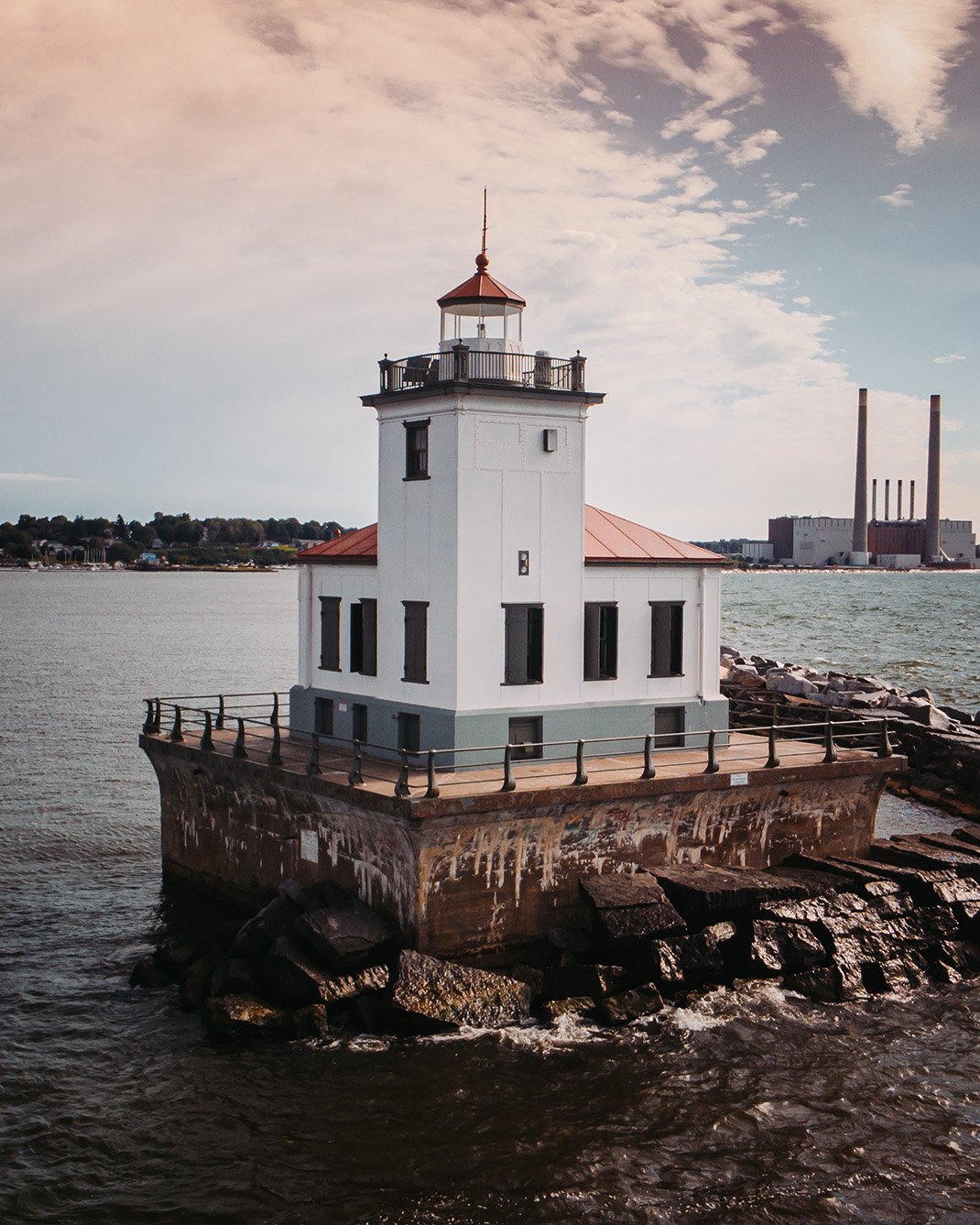
One of the most iconic landmarks in the Port City is the West Pier Lighthouse, sitting in the Oswego Harbor. It has been the subject of countless photos and paintings over the years. But now, you can get in the picture yourself, by hopping on a tour boat and traveling out to the lighthouse.
Tours are available on weekends and some Thursdays during the summer. Tickets are $35 for adults and $20 for children, 5 through 12. Tickets can be purchased through the museum’s website under the Visit Tab. Visitors board a boat on Wright’s Landing in the harbor.
This is actually the fourth lighthouse, the first one being built in 1822 on the east bank, below Fort Ontario. The current one was constructed in 1934 as part of a harbor enlargement project and as a means to improve the lights in the harbor, according to the H. Lee White Maritime Museum website. It is still an active aid to navigation.
Arriving at the lighthouse, visitors are greeted by a guide and as they ascend the staircase to the top of the tower, they will get the chance to see one-time living quarters of the lighthouse keepers and the early Coast Guardsmen, as well as the radio and signal room. The rooms have been refurbished and period furniture has been put in place, according to Mercedes Niess, executive director of the museum.
Once at the top, visitors can see the automated lens, which was installed in 1969, replacing the original fourth-order Fresnel lens and marking the end of light-keeping as a profession in Oswego. That Fresnel lens is in the care of the Maritime Museum.
And they can also go out on the deck, which offers a different perspective of the lake, the harbor and other landmarks on the Oswego horizon.
The history of the lighthouse, though, has a tragic chapter. In December of 1942, a brutal winter storm hit the area, causing a boat carrying eight members of the Coast Guard to overturn during a storm by the Oswego Lighthouse. Six men died and two survived.
Visitors can learn more about the lighthouse and the harbor at the museum, whose collections chronicle about 400 years of regional maritime history. A new exhibit is “Shipwrecks of Upstate New York,” featuring 25 3-D printed and hand-painted models of local shipwrecks; and in commemoration of America’s 250th is an exhibit of watercolors by Oswego native and World War II vet Frank Kraft. WWII history buffs won’t want to miss the LT-5 Major Elisha K. Henson, the 114’ ocean going tugboat which shot down a German Folke-Wulf on June 9, 1944.
SALMON RIVER LIGHTHOUSE
5 Lake Road Extension, Pulaski, NY 13142
www.salmonriverlighthousemarina.com
The Salmon River Lighthouse, which sits at the mouth of the Salmon River, is unique for several reasons.
Formerly called the Selkirk Light, it is only one of four lighthouses left in the United States that still have the birdcage lantern room and it is one of just a few that provide accommodations to overnight guests.
The structure was built between 1837-38 for about $3,000, its lights were illuminated with burned whale oil and the keepers, who worked for eight to nine months during the shipping season, made about $350 a year.
When a canal that was supposed to connect the Salmon River to Lake Ontario and the Erie Canal, failed to materialize and the mouth of the river began silting in, the area saw a drop in commerce. So, only after about 20 years, the lighthouse was deactivated in 1858.
Nearly 40 years later, German émigré, Leopold Joh, bought the lighthouse at an auction from the federal government for $155! He built a resort, which included the lighthouse and its beautiful views of the lake and excellent fishing drew guests from as far away as New York and Philadelphia. A few years later, under different owners, historical accounts say that the resort and the area also proved attractive to smugglers during Prohibition.
Current owners, the Barnell and Ellis families, bought the lighthouse and surrounding grounds in 2014 and they have been restoring and improving the site since.
Today, the lake and fishing — and of course, the appeal of staying in a lighthouse — are still attractive to visitors.
Renters can opt for the first floor, the second floor or the entire structure. The first floor can accommodate up to four guests and has a full kitchen, full bathroom with shower, dining area, living room with a pull-out double-size bed/couch and a bedroom with a double bed. The second floor can also accommodate four guests. Its website says it has two double beds in the main room; the secondary room has a couch, TV, mini-fridge and a coffee maker and a newly renovated full bathroom.
And there is a fireplace on the first floor that dates back more than 100 years and while it’s not functional, there are hundreds of river stones that former guests have written messages on, dating back to the early 1900s.
But in order to provide the guests privacy, Abby Burt, the lighthouse manager. said that tours to the top of the lighthouse and its birdcage covering are limited to renters only.
 TIBBETTS POINT LIGHTHOUSE
33435 County Route 6, Cape Vincent, NY 13618
http://tibbettspointlighthouse.org
If it weren’t for the American Revolution, the Tibbetts Point Lighthouse might not exist.
This, according to Glenn Fritz, of the Tibbetts Point Lighthouse Historical Society.
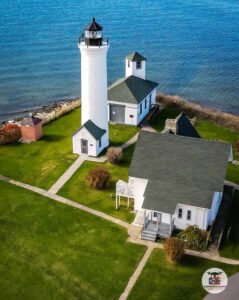
He explained that Revolutionary War veteran John Tibbetts was given 600 acres of land at Tibbetts Point as payment for his service and he transferred three acres of the parcel to the federal government to build a lighthouse. That structure — a rectangular wooden tower, was built in 1827, but by 1854, it was replaced by the present one, made of concrete and it stands 60 feet high.
The tower was outfitted with the Fresnel Lens, which was made in France and was standard in U.S. lighthouses for decades. Most of the lighthouses eventually replaced Fresnel with automated lights, but it’s still in operation at Tibbetts — the only one of its kind left on Lake Ontario — and it, reportedly, can be seen 16 miles away.
While visitors cannot access the tower, because it remains operational, they can enter the atrium area, stop at the museum–gift shop and view the two buildings that served as quarters for the lighthouse keepers. After the lighthouse was automated in 1981, the U.S. Coast Guard, which had assumed lighthouse duties in 1939, moved off-site and those buildings sat empty until 1984 when they became a youth hostel. The hostel would close 30 years later.
The grounds, where Lake Ontario and the St. Lawrence River meet, are open 24/7 and according to Fritz, if you’ve never seen a sunset here, you’re missing out on one of the best free shows in the state.
If you’re navigating along the coast of Lake Ontario this summer, exploring these lighthouses and you find yourself at a particular tower on Aug. 7, toast the beacon in honor of National Lighthouse Day!