

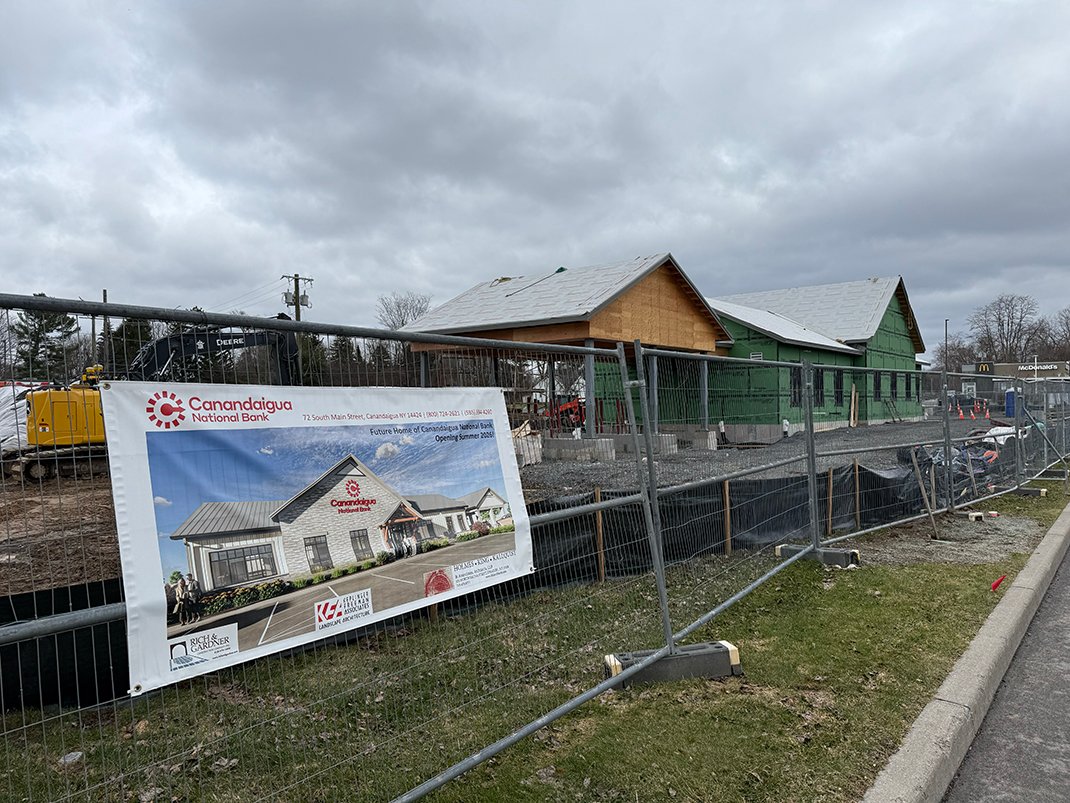
Three more are planned for Onondaga County. The branches are expected to be fully up and running in the coming months
By Stefan Yablonski
Canandaigua National Bank has opened a new branch in Syracuse. It is planning three more in Onondaga County.
“We opened one right in downtown Syracuse at 333 W. Washington St.. The hard opening happened a week or so ago,” Frank Hamlin, the bank’s president and CEO, said during an interview March 6. “We’re using that as a base of operations as we go through to find local talent because we have another three that are going to be coming online as we progress into the summer.
Canandaigua’s main branch is on Main Street, Canandaigua. The bank now has 26 branches; and an office in Sarasota, Florida, which isn’t a branch but a wealth and trust office.
“We had been considering the Syracuse area expansion for a while. The Syracuse market seemed like a good opportunity. That’s how we ended up where we are right now,” Hamlin added.
The other Onondaga County branches the bank plans to open are:
• 7507 Oswego Road, Clay
• 6805 E. Genesee St. in DeWitt in the Wegmans shopping plaza
• 8065 Brewerton Road in Cicero
Previously, they expanded in the Rochester area. Before that, they were predominantly in Ontario County.
“Now we will have a more robust physical presence in Onondaga County,” Hamlin said.
The bank started out in Ontario County in 1887. It is an independent, community bank. It has shareholders, but isn’t a publicly traded company — decisions are made locally, based solely on what is best for the customers, the communities, its employees and shareholders, according to its website.
Canandaigua has grown along with the communities it serves by offering a wide range of competitive banking options and the personal service that builds long-lasting relationships, according to Hamlin — “not measured in years, but in generations.”
“We had basically saturated the market and said, ‘you either stop growing and deplete your opportunities for your employee base or you grow.’ And so, we at that point, about 40 years ago, we pushed into the Rochester market. We expanded into the Rochester market and when we did that we did multiple branches within a short amount of time,” he explained. “We jumped in there and grew quite a bit.
“A few years back, around 1995, we found ourselves in a similar position in that we were doing well, but as you build capital you have to either leverage that capital or you need to return it to the shareholders. We pay dividends. That’s a short-term cop out to dividend all your capital out because that means you don’t have the creativity or initiative to go ahead and leverage your capital in a way that allows for the extended opportunities for your employee base as well as for the communities which you are serving.”
So, they started looking around at different geographies and the competition mixes and the feel of the communities around the areas.
“You could either go east, west or south. The most obvious place to go was to the east, to Onondaga County, and so that is the direction we choose,” he said. “We have a predisposition to grow organically. I know that is not what they teach you in business school. You’re supposed to acquire and then you are supposed to work out the middle in order to get the efficiencies for the purchase. That just destroys human capital.
“That just doesn’t fit our culture. We have actually had a lot of cooperation with local competition within the Onondaga market because, frankly, we have situations and opportunities that other people can also take advantage of or leverage.”
It has been a surprisingly good entry into the market, he added.
“We have plans to — and are already breaking ground — to put up multiple locations as an indication that we are here to stay. This isn’t a come and go like a lot of the larger institutions will do. Most think they can get more profitability out of another region or out of another part of the country. [For us] this is a step-by-step building relationship, based in banking and community banking approach,” he said.
Hamlin said he is not a fan of the acquisition concept.
“I’d much rather come in and cooperate and work together with those in the community — both within the financial services communities as well as the communities themselves — through an organic path,” he said.
The history of Canandaigua National Bank has been very much kind of a 50-50 mix of a lending portfolio and customer portfolio standpoint, he added.
“Our balance sheet is 50/50; consumer and mortgage and car loans etc and then 50% commercial lending. We are a community bank and community banks are about individuals and small business. Individuals create small business — it’s very circular,” Hamlin explained. “We are a little more than $5 billion in assets right now. We are at a nice size where we are big enough and have the tools while also being responsible or responsive and valuing the actual relationship as opposed to just the financial aspect of any kind of relationship we might have.”
Canandaigua National Bank has about 600 employees, Hamlin said.
“For community banking you need people who are ingrained with those communities so we can understand the community and also build trust within it,” he said. “We have three more branches coming online very soon and that of course requires the requisite staffing. We are looking around and seeing if we can find individuals who meet our cultural requirements.”
Opportunity knocks
Micron provides a huge opportunity for Onondaga and the surrounding counties. The enormous interplay and positive impact will be felt up and down the Thruway, according to Hamlin.
“This creates a lot of opportunity for the people who come here to get educated to stay here to work. It’s one of the most beautiful places in the world. We got it all right here,” he said. “There is a lot of collaboration in Central New York right now. When people start rowing in the same direction, we can really move a lot of weight. It is very exciting and it’s important to keep the momentum going.”
Will the bank’s next expansion be in Oswego County?
“I am a strong proponent of organic growth. As we settle in and become more acclimated to the environment [in Onondaga County area], that will help us make decisions in terms of where we might be able to leverage our capabilities in other markets,” he said. “We are always thinking about how we can continue a community bank model that thrives not only for the community but also for the employee base. As we grow, it also creates opportunities for our employee base.”


