


New book traces history’s founding mothers through parts of Oswego and Upstate New York
By Tom and Jerry Caraccioli
If you ride around the city of Oswego, residents and visitors get a virtual history lesson from east to west, north to south every day.
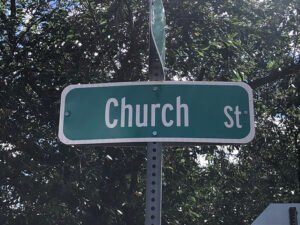
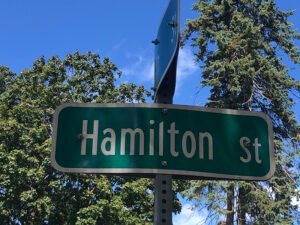
Names like Schuyler, Hamilton, Church, Bunner, Lawrence, Montcalm, Franklin and more represent streets, parks and other notable areas of the Port City that are a virtual who’s who of 18th century dignitaries, founders and influencers with connections to the earliest days of our nation.
Author and University of Michigan professor Molly Beer, who grew up in neighboring Alleghany County in Angelica, calls attention to some of these historical names in her new book (Angelica: For Love and Country in a Time of Revolution) about one of America’s “Founding Mothers.” Maybe best known these days as a character in the worldwide musical phenomenon show Hamilton, Angelica Schuyler Church was much more than Alexander Hamilton’s sister-in-law.
Upon telling the story of Schuyler Church, a story she was intimately familiar with having grown up in the rural Western New York town of Angelica, Beer felt the need to take a step back and contextualize one of America’s foremost female forebears and diplomats before women were ever thought of such.
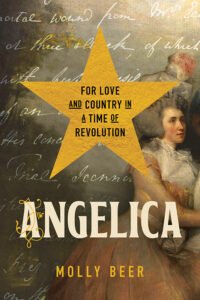 “I’m from rural New York and grew up on a dairy farm,” Beer said. “The more time I spent out of the United States, the more I thought about what it means to be an American. I had to write about what I knew and that was home in Angelica. But to even begin to talk about the place I was from, people needed to know about Angelica. There needed to be a researched, not speculative, telling of her life to identify her place in history. How my town was founded was emblematic of how this country was founded. I wanted to talk about the founding of America through the microcosm of the founding of my town.”
Angelica Schuyler Church was born in Albany to General Philip Schuyler and his wife, Catherine Van Rensselaer. The Schuylers were well-to-do and the general and his family were close to many political notables and Revolutionary Americans including the country’s first President George Washington and his wife, Martha.
“Angelica was extremely well-educated and trained to be a woman whose role was to guide men — at dinner parties where politics was discussed, to answer the mail, to facilitate relationships,” Beer said. “There isn’t a biography written about Thomas Jefferson or Alexander Hamilton that didn’t grapple with her persistent presence. Angelica was an influencer.”
Despite being considered “second-class citizens” in the burgeoning American nation, the colonies and world were filled with powerful women during the time of the Revolution. And although Schuyler Church was a lady of society, that didn’t mean she wasn’t aware and involved in the rebellious business of the day. The stories of the role women played during the times are an underlying theme of Beer’s story.
 “There are a lot of unrepresented voices, but I just wanted to show her voice was a little louder,” Beer said. “If we include more women in that national story it will help women, 1) become interested in history and 2) understand the possibility they can become part of making history moving forward.
“It’s problematic after 250 years, a country premised on equality and justice hasn’t had one [female president] like so many other countries have. It demands some deep introspection. I tried to write the book as apolitically as I could.”
Schuyler Church’s life spanned the time during which the colonies eventually became the United States of America. She served as an unofficial diplomat in Paris and England, where she charmed a coterie of artists and salonnières on behalf of America’s elite at home and diplomats abroad like Benjamin Franklin and Thomas Jefferson. Angelica “The Influencer” maintained a transatlantic network of friends and acquaintances that provided her with reliable information used to forward the efforts of many of history’s most important founders and leaders of the 18th century.
As the story of America unfolded westward at the end of the revolution and beginning of the 19th century, so did Angelica and her family. Her son, Philip Church, made his way west through the wilderness of New York state, no doubt trekking through what is now known as Central New York and the counties that comprise the area. Upon reaching Hornell, where coaches could no longer go on, settlers had to bushwhack their way forward. Twenty-one miles west, Church found land and purchased it to create the village of Angelica, named after his mother.
“Angelica would’ve come through the area to get to Western New York,” Beer said of the woman who died in New York City in 1814. “The stagecoach would’ve come through Central New York, north of the Finger Lakes before heading south at Bath.”
Connections to Oswego
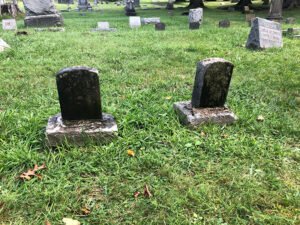
Connections to the area didn’t end with Angelica or her son. John Barker Church, Angelica’s husband and Hamilton’s brother-in-law owned land in Oswego they purchased in 1802. Years later Angelica and Barker Church’s daughter, Elizabeth, eloped with Rudolph Bunner. The couple was disowned by the family because Bunner was a Democratic Republican and Church’s uncle, Hamilton, who was a Federalist Party member, was killed by Aaron Burr, a Democratic Republican. The couple moved to Oswego in 1820, where Bunner established a newspaper in the Port City in 1852, the Oswego Daily Palladium, which ran until 1906. It served as a forebear to Oswego’s current local newspaper, The Palladium-Times. Elizabeth Church Bunner lived in Oswego until her death in 1867 and is buried in Riverside Cemetery.
“We’re going to spend next year commemorating and contemplating the 250th anniversary of this country,” Beer said. “Having women’s stories as part of that commemoration and contemplation is important. Angelica was a very important person and not the only woman in the book. I tried to bring in as many women as I could. This is a period for reflection and there will be a lot of talk about how [America] got started and what was the intention at the onset. Women were doing lots of things. They weren’t doing male things — fighting wars, signing documents, starting businesses — but that doesn’t mean women weren’t a huge part of it.”
The names of streets, parks and towns are proof of that.
 Tom and Jerry Caraccioli are freelance writers originally from Oswego, who have co-authored three books: “Striking Silver: The Untold Story of America’s Forgotten Hockey Team,” BOYCOTT: Stolen Dreams of the 1980 Moscow Olympic Games” and “Ice Breakers: A Kid’s Guide to Hockey and the Greatest Players Who Changed the Game.”


