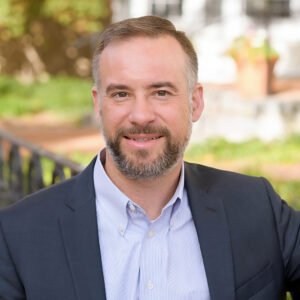
CEO Mike Backus says hospital is still at risk of losing funding as a result of the Trump administration’s Big Beautiful Bill
By Stefan Yablonski
Oswego Health has certainly had a busy and exciting year, according to Michael Backus, president and CEO.
“And none of it is by accident,” he said. “Every step we’ve taken — the $14 million renovation at Oswego Hospital, the opening of the new Fulton Medical Center Campus and several other initiatives behind the scenes — has been guided by our strategic plan and by our core belief that we have both an obligation and an opportunity to do what’s best for this community.”
As a nonprofit health system, Oswego Health is obligated to reinvest every dollar back into the community—whether that’s in its infrastructure, its technology or, most importantly, its people, he said. “We also see tremendous opportunity to modernize care, improve access and ensure high quality, local healthcare remains strong across our entire region. The projects we’ve launched this year are direct reflections of that balance.”
Not slowing down
Looking ahead, that momentum doesn’t slow down, Backus said.
“Our strategic plan calls on us to evaluate where patients are already choosing us for care. That data gives us a clear opportunity to expand into additional markets where access is limited and where our presence can make the biggest impact,” he explained. “You will continue to see us strengthen core services, invest in patient experience and ensure our talented workforce has the resources and support to deliver exceptional care.”
What’s next for Oswego Health is simple — continuing to grow, innovate and evolve — always guided by its mission, its plan and its responsibility to the communities it proudly serves, he added.
The Oswego Health is still at risk of losing funding as a result of the Trump administration’s Big Beautiful Bill.
“There is real financial risk for community hospitals because of this legislation. Some of the biggest changes, especially to Medicaid, take effect in 2027. But we are already seeing ripple effects. For example, new federally required work-eligibility verification for Medicaid recipients will cost millions in bureaucracy just to implement. Requirements around citizenship eligibility will cause some individuals to present for care without insurance furthering care that we deliver with no reimbursement,” he said. “Without knowing how many of our patients will lose insurance coverage makes it unknown at this time exactly what this will cost Oswego Health. But the potential impact is significant enough that we are preparing now.”
However, they are not approaching change from HR1 from a place of fear, he added.
“We are approaching it from a place of leadership. I have been working closely with HANYS [Healthcare Association of New York State], the Iroquois Healthcare Association and our local and state elected officials to ensure Oswego Health is not only part of the conversation, but helping shape it,” he said. “In recent communications to state leaders, I made it very clear: we are not a corporation; we are a community. We do not answer to shareholders. We answer to our neighbors and we will always care for every person who walks through our doors, regardless of citizenship or ability to pay.”
At the same time, Oswego Health is advocating for common sense reforms that will help rural hospitals remain strong — modernizing outdated regulations, such as the certificate of need process, easing workforce barriers, supporting technology adoption and securing real cybersecurity funding rather than unfunded mandates, according to Backus.
“We are not asking for handouts — we are asking for the flexibility to continue delivering high-quality care close to home,” he said.
Internally, Oswego Health has already taken steps to strengthen its long-term sustainability. Earlier this year, it made some important decisions that allowed it to identify more than $2 million in operational improvements, while still moving ahead with major projects like the Fulton Medical Center Campus and significant investments in imaging and specialty services. Backus said.
“So yes, HR 1 presents challenges. Oswego Health is not retreating though. We’re advocating, we’re preparing and we’re staying true to our mission. No matter what happens in Washington or Albany, our commitment to protecting our patients and preserving the future of local, independent healthcare in this community remains unchanged,” he said.
Changing perceptions
“While I understand that perception [that bigger hospitals are better], we have grown considerably over the past five years as a health system led by our hospital. We have multiple locations spread throughout our primary service area, which is growing and we are seeing patients living in our secondary service area begin to choose us. We provide high-quality care in a community setting and collaborate with others where appropriate to maintain local services,” he said. “It is not a competition — it is care collaboration close to home. That’s how we’re growing our health system and improving the health of our community.”